

A Different Way of Seeing
Words by Hannah Tapping
Ally Fraser discovers poetry in the overlooked, making and creating with curiosity.
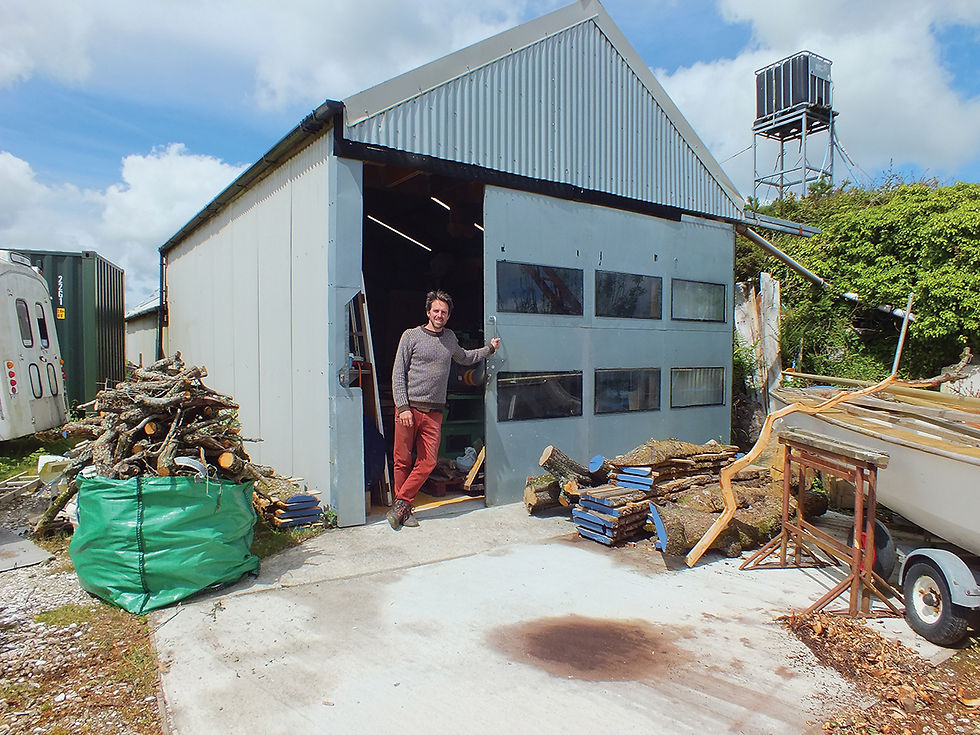
Ally outside his workshop
Whether creating bespoke furniture or working with discarded materials, Ally Fraser, has an instinctive ability to recognise beauty and possibility in overlooked materials and to transform them into objects that sit somewhere between furniture, sculpture and art.
There is a particular kind of vision required to look at something discarded and imagine what it might become. A weathered piece of timber, a broken concrete post, a sheet of perforated steel: to most, these are remnants of something finished, their usefulness exhausted. To Ally Fraser, they are the beginning of a conversation. From his workshop just outside Falmouth, Ally has built a practice around this instinct for reimagining the familiar. A furniture maker, artist and skilled joiner, he moves between bespoke commissions and more experimental work, creating pieces that are as much about the character of their materials as the purpose they ultimately serve. His work is informed by a sensitivity to form, texture and the traces left by previous lives, alongside a willingness to explore what might happen when seemingly unrelated elements are brought together.
“I see value in discarded things, where other people just see rubbish,” he tells me. It is a simple observation, but one that speaks to the heart of his practice. For Ally, the process of making is not simply about imposing a design upon a material. It begins with looking, noticing and remaining open to possibility. Sometimes he seeks out particular objects; more often, he suggests, they find their way to him. Rather than beginning with a fixed outcome and sourcing materials to fulfil it, Ally allows the material itself to influence the direction of a piece. A discarded object might suggest a new form, while a knot, crack or old joint can become the detail around which an entire design develops. What others might regard as a limitation becomes an invitation.
Ally’s relationship with making began long before the establishment of his own workshop. At primary school, he remembers creating a simple desk organiser, working outdoors with plywood and a portable workbench. Even then, the possibilities extended beyond the original brief. Later, at secondary school in Kent, design technology offered greater access to tools, machinery and the freedom to experiment. An inspiring teacher helped nurture an interest that would become a defining part of his life. He went on to study furniture design at Sheffield Hallam University, where the theoretical and technical aspects of design were complemented by the opportunity to explore ideas in the workshop.
While the course involved drawing, modelling and computer-aided design, it was the practical work that drew him in most strongly. The workshop became a place to test ideas, work with different materials and discover their individual properties through experience.
Cycle dresser
After graduating, Ally returned to college to undertake a three-year NVQ in wood machining at Leeds College of Building. He then spent five years working for joinery companies, making windows, doors and staircases. This period brought together the two sides of his training: the creative freedom of furniture design and the precision demanded by traditional joinery.
In 2011, he established Ally Fraser Woodworks, moving towards independent commissions and bespoke furniture while continuing to take on specialist joinery projects. The change gave him greater freedom to explore ideas beyond the requirements of a client brief. A particularly affordable workshop space also allowed him to accumulate reclaimed materials and found objects, creating room for an artistic practice to develop alongside his commissioned work. That freedom remains important. Although his work encompasses everything from substantial architectural joinery to smaller functional objects and sculptural pieces, the underlying impulse is consistent: to explore what a material might become, rather than simply what it is expected to be.
One of Ally’s favourite personal projects, Mesh Light, offers a particularly compelling illustration of this approach. Its origins lay in two objects that had little obvious connection: a broken concrete gatepost and a sheet of perforated galvanised steel. The concrete post had caught his attention years earlier. He could see its potential but had not yet found the right material to bring the idea into focus. Then, while exploring an abandoned building, he came across the missing element.
“The next day when I took it back to my workshop and washed it off. I knew instantly that this would work with that concrete gatepost. I drove to collect it straight away.” The eventual pairing is an example of the way his work develops through observation and instinct. The two materials, each carrying its own history and visual character, acquire a new relationship when brought together. Neither needs to be disguised or made to appear pristine and it’s their differences that are precisely what give the resulting object its presence.
There is a patience to this way of working, a willingness to wait for the right conjunction of materials rather than forcing an idea into existence. It also reveals something about the nature of his creativity. Although Ally may have a sense of where a piece could go, the route towards its final form is rarely entirely predetermined.
His Christmas tree coat hooks began with a similarly everyday observation. A Christmas tree, cherished and carefully decorated throughout December, quickly becomes unwanted once the festivities have passed. Rather than seeing its discarded branches as waste, Ally began experimenting with ways to retain their character, stripping away the bark and cutting the branches back to create small hooks.
The transformation is modest in scale but rich in meaning. Something associated with a fleeting moment of celebration is given a second purpose, its former identity still visible in its new form. It is an approach rooted in resourcefulness, but it also asks us to reconsider our assumptions about value: how quickly we abandon objects, and how much potential remains in the things we no longer need. These hooks, along with other reclaimed products including innovative cube toys, wooden belt buckles and shelves are available to buy from the website.
For Ally, the distinction between functional furniture and sculpture is not always particularly useful. A table may serve a practical purpose while also possessing the qualities of an artwork; a sculptural object may have a presence that is inseparable from its material construction. Ultimately, he leaves the interpretation open. The viewer brings their own perspective to a piece, deciding whether to regard it as an object for everyday use, a sculptural form or something that inhabits both worlds.“I’m not the one to decide or determine whether it’s a sculpture or just a table. As they say, beauty is in the eye of the beholder.” This openness extends to his commissions.Ally enjoys working with clients who are willing to leave space for discovery, offering a sense of what they need rather than an exhaustive specification of what the finished piece should be. A meeting, a conversation and a visit to the space provide the starting point. From there, the design can evolve in response to the architecture, the intended use and the character of the people who will live with it.
His work is therefore varied by nature. One commission might involve the clean lines of a contemporary staircase; another could incorporate reclaimed oak that once formed part of a set of lock gates. He has also undertaken extensive commercial projects, including the design and making of two shops for wine merchant StarmoreBoss, where displays and fitted elements must combine visual impact with the practical demands of their setting. Such projects demonstrate the technical precision underpinning his more experimental work. The freedom to explore depends upon a thorough understanding of how materials behave, how joints are constructed and how an object will function. Creative instinct and practical skill are not opposing forces here; each informs the other. “I consider myself an artist in everything I do. It’s a way of being. It’s a way of seeing the world. It doesn’t really matter what I’m making, whether it’s a piece of furniture or a loaf of bread in the kitchen.” It is a revealing perspective. For Ally, artistic practice is not confined to a particular category of object or a designated studio activity. It is a way of approaching the world, remaining curious and finding room for invention in the everyday.
Wood remains his first passion. Each piece is individual, shaped by the conditions in which the tree grew and carrying physical evidence of that life. Working with reclaimed timber introduces another layer of history: marks, old fixings and joints that hint at the object’s previous purpose. “If a material has already been used for something and it’s got marks in it from a previous life, I embrace that. For other people that would be a limitation, for me, it’s a starting point.” Rather than erase these traces, he chooses to work with them. Knots and cracks are welcomed, their irregularities offering a visual richness that uniform, untouched surfaces cannot replicate.
This appreciation of imperfection is integral to the way Ally conceives a piece. The marks of time become part of its identity, allowing the material’s previous life to remain present within its new one. Importantly, his practice is not limited to reclaimed materials. He also works with new materials, selecting and combining them according to the demands of each commission or the possibilities of an emerging idea. The point is not to impose a single material philosophy upon every project, but to respond thoughtfully to what each one requires. Whether working with newly sourced timber, reclaimed oak, concrete, metal or an unexpected found object, he approaches the material as something to understand rather than simply control.

An example of which is the table created for StarmoreBoss, where rot had left a large void in a huge Beech slab that no amount of wood filler was going to hide. Ever-keen to take the opportunity to do something different, Ally turned it into a herb planter. The same approach was taken to the lockable specials cabinet, created for their highest-ticket offerings. Ally used a rust-pitted oil tank as the carcass for the cabinet which he polished to a reflective shine, creating a craters-on-the-moon surface, as well as hand making the doors and a locking mechanism. By sand-blasting the surfaces of thick toughened glass and running LED strip lights around the edge of them, Ally was able to make the shelves glow in a spectacular, illuminated fashion.
For clients, this means a bespoke piece can emerge from a broad conversation about a space, its needs and its atmosphere. For his personal work, it means following curiosity wherever it leads. For those considering a bespoke piece, the process begins with a conversation. Ally prefers to meet clients, understand their space and leave room for the unexpected. Appointments can be arranged to visit the workshop, although getting in touch in advance is essential. What emerges from that first exchange may be a piece of furniture, a considered architectural detail or something less easily defined. The form will depend on the brief, the materials and the ideas that surface along the way. What remains constant is his belief that making is an act of discovery: a process of looking beyond the obvious and recognising possibilities that might otherwise go unnoticed.
In a culture accustomed to replacing the old with the new, Ally’s work offers a quieter, more thoughtful proposition. It reminds us that materials carry histories, that imperfections can be beautiful and that usefulness need not end when an object’s original purpose does. Sometimes, all that is needed is a different way of seeing.


