As night falls
- Apr 20
- 4 min read
Words by Hannah Tapping
Employing colour, texture and atmosphere to create unique night-time narratives.
Diane Griffiths is self-taught. Hailing from the Midlands, she spent over a decade working in the media industry in London before moving to Newquay in 2017, where she now lives and continues to work alongside painting. “My background in media has shaped how I approach my practice, particularly around communication and authenticity. There’s no single path into art, and that’s something I’ve come to appreciate. I try to stay true to my own voice, focusing on work that feels honest rather than responding to external pressures.”
For Diane, there wasn’t a single defining moment that inspired her to become an artist, more a gradual realisation. “I’ve always been drawn to light and atmosphere, particularly at night, something that began with long exposure photography. I spent a lot of time capturing night scenes with my tripod and camera (now much easier with smartphones), which made me more aware of how light behaves, how colours transform and how environments change after dark. Over time, painting became less about producing an image and more about understanding those moments, why they feel familiar or meaningful. It grew from something occasional into something I wanted to pursue more seriously.”

Painting allows Diane a balance between control and interpretation that really suits what she’s trying to capture, as she explains: “The subjects I’m drawn to; reflections, artificial light, atmosphere, don’t translate in a purely literal way.
I want the work to be recognisable, but also to go beyond representation. Painting gives me the freedom to adjust colour, soften detail and focus on what the moment felt like rather than exactly how it looked. The slower process also reflects the themes in my work, where observation and gradual understanding are central.”
Her work focuses on everyday scenes after dark; places we pass through without thinking too much about them during the day. This might be a petrol station, a queue at a food kiosk, a bus stop, or a stretch of road on the way home. “I’m interested in the shared nature of these experiences, the idea that they’re not tied to one specific place but feel widely recognisable. Light plays a central role, particularly how natural and man-made light transform these environments at night, revealing something quieter and more reflective within otherwise ordinary settings.”
Top: Night Bus | Above: Worth The Wait
The process begins with observation. It’s important for Diane to experience a place first, to understand how it sits within its surroundings and how the elements connect. She then makes mental notes about structure, light sources and atmosphere, supported by reference photos. Back in the studio, she works from a combination of memory and reference, gradually building the painting in layers. “At a certain point, I step away from the photos and allow imagination to take over. The aim is not to recreate the scene exactly, but to arrive at something that feels true to the experience,” she says.
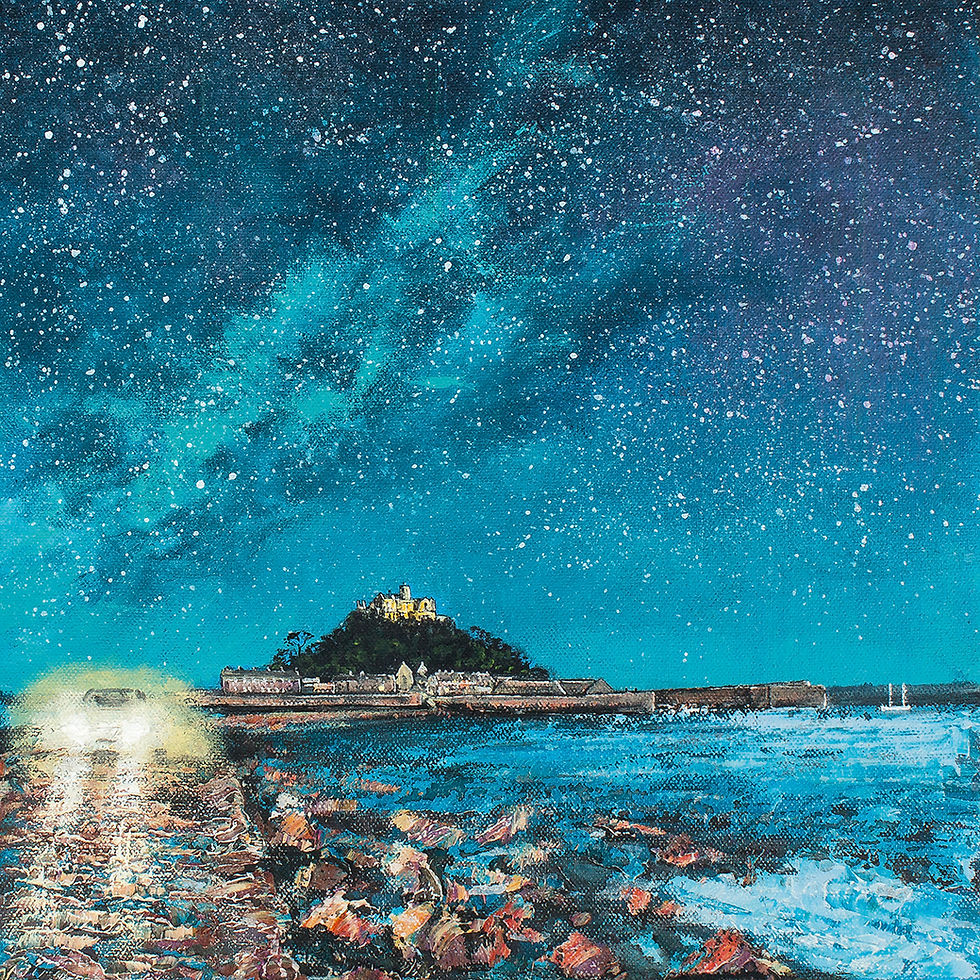
“I primarily work with acrylic, sometimes combining it with other media to build texture and depth. My palette is led by the subject, but night scenes naturally draw me towards deep blues, warm artificial light, and strong contrasts,” adds Diane. “I’m interested in how colour can suggest light rather than describe it directly. Most of my paintings are on square canvases, which allows for a contained, balanced composition. The scale is intentionally accessible, large enough to hold presence, but intimate enough to draw the viewer into the scene.”
Top Left: Stargazing From The Beach | Top Right: Last Train Home | Above: Insert Coin To Begin
Diane’s studio is part of her home and, over time, the spaces have adapted around her work. The dining room has become her main painting area, with other areas used for drying, storage and materials. “It’s not a traditional studio, but it works,” says Diane. “Being in a central space means I’m still part of the household, which I prefer. It’s less about having a perfect studio and more about having a consistent environment where the work can develop over time.”
Diane’s current body of work sits under the umbrella of The Colour of Night, which explores how light transforms familiar environments after dark. Within that, she has been developing a strand focused on quiet rituals; everyday actions like travelling, waiting, or stopping briefly along the way. These are moments that often go unnoticed but feel widely shared. The work continues to develop through new paintings, exhibitions, and submissions to open calls, allowing the series to grow while reaching different audiences.
Diane sees her work as part of a wider conversation in contemporary painting that focuses on the everyday. “There’s a long tradition of artists exploring light and atmosphere, but I’m interested in how that translates into modern, familiar environments.” Within a Cornish context, the work moves slightly away from traditional coastal views and instead reflects the lived experience of place, particularly after dark. More broadly, it sits within a strand of painting that values observation, shared experience and quieter narratives.
Top Left: Mousehole Harbour Lights | Top Right: Driving Home | Above: As Long As The Lights Are On
“I’d like people to recognise something of their own experience in the work. For example, Driving Home is based on a garage in Newquay, but people often connect it to places they know from their own journeys. That sense of familiarity is important to me. My work is less about specific locations and more about collective memory: places we recognise and moments we’ve all inhabited. My aim is to show how the beauty of everyday life, if seen through the right lens, is anything but ordinary.”
Diane’s work can be viewed this year at the following exhibitions: 11th to 24th May – Truro Cathedral, 11th to 19th July – Trenance Cottages and 7th to 21st September – Trerice House. Recent recognition includes the People’s Choice Award at the British Art Prize and the SAA Artists of the Year.