

Best-laid Plans
Updated: Aug 26
Words by Hannah Tapping
Presenting the case for a planning consultant: why they should be your first call.

Planning a development project can feel deceptively straightforward at the outset. Whether it’s extending a home, converting a rural building or bringing forward a larger scheme, the instinct is often to focus on design first. But in reality, the success of any project is determined much earlier – at the point where risk, policy and feasibility are properly understood.
For Rebecca Boyde, Director of Coast to Country Town Planning, this is where the real value lies: reducing uncertainty from the very beginning so clients can move forward with confidence. With over 15 years’ experience – including a decade within local government – Rebecca established Coast to Country Town Planning as an independent consultancy managing the entire planning process on behalf of its clients, from initial feasibility and site appraisal through to the discharge of pre-commencement conditions and, where required, handover to contractors.
Coast To Country Town Planning was established as a practice primarily covering the South West, while maintaining a growing London presence and active instructions in Essex, Dorset and beyond. The diversity of authority types is, she says, one of the most stimulating aspects of her work. “I’ll see a really unique way of looking at an interpretation of the policy in Kensington and Chelsea and consider how that approach could be applied to clients’ applications elsewhere in the UK.”
Rebecca brings an insider’s understanding of how planning decisions are made. Having worked across a wide range of applications, from householder developments through to more complex and sensitive schemes, she understands both the technical requirements and the broader pressures that shape decision-making.
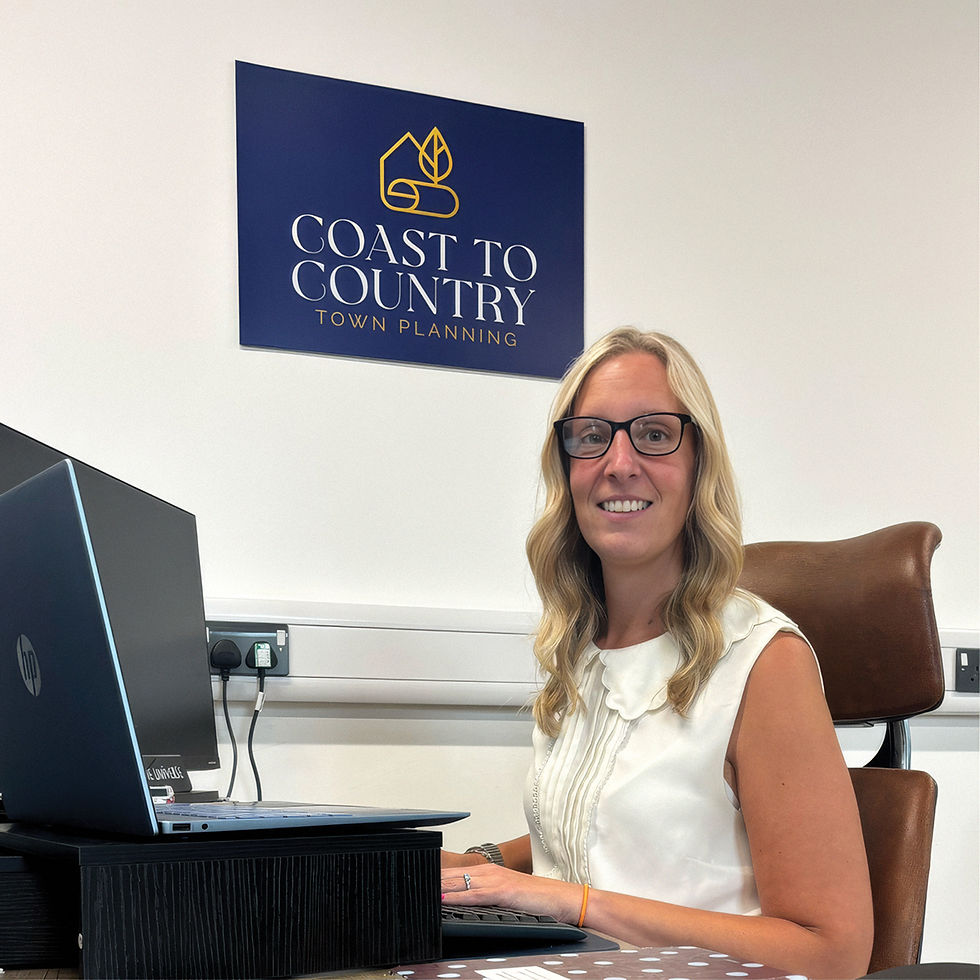
“My experience gives me a clear view of how planning authorities approach proposals, how policy is applied and where the key risks typically sit,” she explains. “That allows me to guide clients towards solutions that are realistic, policy-aligned and ultimately more likely to succeed.”
This approach often begins by challenging assumptions early. Rather than progressing a proposal that may face obstacles further down the line, Rebecca works with clients to test ideas at the outset, identifying constraints, assessing feasibility and refining the direction before significant time and cost are committed. The benefit of this early-stage input is simple but significant: avoiding unnecessary redesign, reducing the risk of refusal and saving both time and money across the lifecycle of a project.
Coast to Country Town Planning supports clients through the entire planning journey. While every project is different, the process typically follows a clear path: starting with feasibility and site appraisal, moving into strategy and positioning, assembling the right consultant team, managing the application process and supporting delivery through to conditions discharge and handover where required. By structuring the process in this way, clients are able to see clearly how their project will progress and where key decisions need to be made – bringing greater clarity to what can otherwise feel like a complex and uncertain environment.
A key differentiator is Rebecca’s role as a single point of coordination throughout. For most projects, she brings together and manages a multidisciplinary team, which may include architects, transport consultants, ecologists, heritage specialists and other technical advisors. Rather than the client navigating multiple inputs independently, Coast to Country Town Planning provides a joined-up service, ensuring that all disciplines are aligned and working towards a shared objective.
“It’s about putting the right team in place and making sure everything is properly coordinated,” she says. “Clients don’t need to manage a dozen different conversations – they have a clear line of sight and a single point of accountability.” This coordinated approach is particularly valuable as the complexity of planning continues to increase. Even relatively modest schemes can require input across access, drainage, ecology, heritage, and environmental considerations. In addition, changing policy requirements and local variations between authorities mean that no two applications are ever quite the same.
Rebecca’s experience across different regions – from the South West to London and beyond – provides valuable perspective in navigating these differences. Exposure to a wide range of authorities allows her to adapt strategies, apply lessons learned and position applications appropriately depending on the context.

Alongside proactive applications, Coast to Country Town Planning also supports clients in more complex or time-sensitive situations. This can include retrospective applications, where works have already taken place, or projects requiring a pragmatic, risk-aware approach to move forward at pace. In each case, the focus remains the same: helping clients make informed decisions with a clear understanding of the risks involved. For clients, this translates into a more structured, considered and ultimately more predictable process. By addressing uncertainty early, aligning proposals with policy and coordinating the right expertise, the likelihood of delay, redesign or refusal is significantly reduced.
Just as importantly, Rebecca’s network forms a key part of the service offering. Over time, she has developed trusted relationships across a wide range of professional disciplines – from legal and finance through to specialist consultants – enabling her to bring in the right expertise at the right time and ensure each project is properly supported. Whether supporting a single property extension, a heritage-led refurbishment or a larger residential scheme, the underlying principles remain consistent: understand the constraints, develop a clear strategy, assemble the right team and manage the process with care and precision.
In an environment where planning is becoming increasingly complex and resource-intensive, that early clarity is more valuable than ever. For clients, it means making better decisions from the outset, with a clearer understanding of what is achievable and a much stronger foundation for success. “In planning, uncertainty is where projects tend to lose time and momentum,” Rebecca says. “Our role is to remove as much of that uncertainty as possible at the outset, so clients can move forward with clarity and confidence.”


