Fired with Passion
Words by Jamie Crocker
The glass artist whose Cornish work refuses to become moribund.

There are days when Jo knows exactly what she needs to achieve. A commission has a deadline, a client is expecting samples or a gallery requires stock. Then there are days when the work begins with little more than an idea and a willingness to experiment. It is this uncertainty, inherent within the nature of the process, that still excites her.
After more than 30 years working with glass, Jo continues to find satisfaction in not knowing precisely what will emerge. Experience allows her to make informed choices, yet she remains drawn to the element of surprise that sits at the heart of the process. The kiln has a habit of confounding expectation, allowing reactions to unfold, colours to shift and deepen, and textures to develop in ways that remain beyond complete control. In doing so, the material retains a delinquent independence that keeps complacency at bay, encouraging a restless curiosity that refuses to permit the comforts of smug repetition.

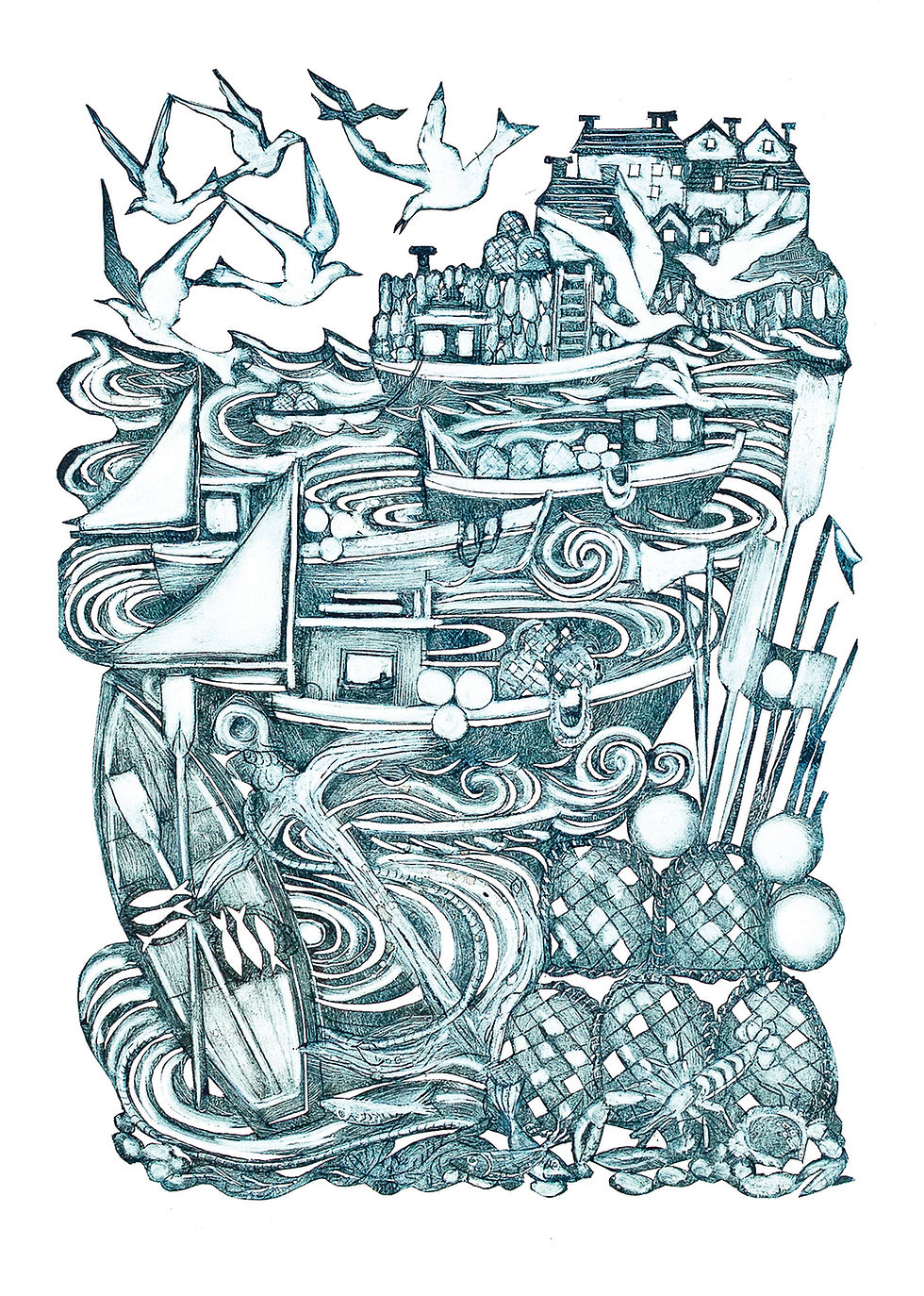
Across Cornwall, her glassware has become instantly recognisable. Coastal influences run through much of her work, with fish drifting across panels, sea blues appearing in endless variations and surfaces seeming to have been shaped by currents or weather. She expresses the Cornish seascape as a fluid wellspring of ideas rather than a subject to be quantified, named and sealed in amber like a creature that has long since perished.
Her entire approach makes for an unusual business. Jo runs not just a studio but a growing retail operation, with shops in Truro and Dartmouth alongside her Launceston base, and she is currently exploring other locations that feel right, further afield. The expansion has been driven by financial necessity as much as ambition. Rents have risen sharply since Covid, glass costs have climbed 50%, energy bills have spiralled, and the business reached a point where breaking even required more sales than a single Cornish market could support. So she did what any pragmatist would do: she opened more shops.
What has surprised her is where the audience came from. At the Dartmouth opening, 40% of visitors already knew her work. The remaining 60% had never heard of her – a new set of patrons, drawn to the same aesthetics that have always animated her pieces. Truro, which she had doubted because it is not coastal, turned out to be a stronghold. In fact, her research has shown that places that have a high cluster of independent traders are the ideal setting for her wares. For anyone who’s visited Cirencester, or Whitstable in Kent, whose high street has been described as among the most diverse in the country, this symbiotic relationship will be obvious.
The business logic here is not complicated; it curiously aligns itself with what informs her pieces – sink or swim. Jo Downs Glass has, over 30 years, built something that imitators find difficult to replicate in full. The brand is strong enough that its presence on the high street signals something to a particular kind of customer – someone who wants an object made by a person who cares deeply about how it was made and whose personality and vision resonate within that piece. This quintessence matters more and more as fused glass has grown in popularity, bringing with it a wider market and, inevitably, a lower tier of product. Jo has seen the copies: badly made pieces in gift shops, objects that bear a superficial resemblance to her work but lack anything underneath. She does not find this particularly threatening and explains why with characteristic directness. She has already moved on. Whatever someone is copying now, is work she has left behind.

The techniques that make her pieces distinctive are largely her own invention, developed over years of studio practice that has no fixed endpoint. There are around 15 projects in progress at any given time, alongside commissions that arrive with their own deadlines and requirements. She has a particular affection for larger statement pieces – circular windows a metre across, splashbacks at a metre and a half by a metre, wall installations that function as an environment rather than just decoration. Given a genuinely open brief, the kind that specifies a theme and a space and then stands back, she produces work that she regards as closest to what she is actually capable of. The commissions where a client effectively dictates placement and content – fish here, detail there – are a different kind of job. Skilled craft, certainly, but not the same thing.

Teaching forms another strand of the work. Jo runs masterclasses, including sessions in Spain where she has recently been spending more time, and what the teaching reveals about her practice is instructive. In a recent one-to-two session with long-standing clients, one student could surrender to the uncertainty of the process. They could place materials, put them in the kiln, and wait with genuine openness for the result. The other could not. She needed to know what was coming, wanted to control the outcome, and found the not-knowing actively distressing. The contrast was, as Jo reflects, quite revealing about personality. Her own position is firmly with the first student. The surprise, when the kiln opens, is where the wide-eyed, eager anticipation finds satisfaction.
Spain is beginning to exert its own sanguine persistence on her work. The palette Jo has used for 30 years is coastal, relying upon blues, deep greens, the colours she encounters every day in Cornwall. In inland Spain, the landscape runs to warm autumnal tones: rusts, yellow and orange, colours she has not worked with much and which require a different chemistry to achieve. It is a landscape that cannot be ignored by someone of Jo’s temperament, slowly inveigling its way into her creative process – hard blue skies, ochre hills and terraces of olive trees that seem to hold the sun long after evening falls. In such a country, where light strikes stone with fierce clarity and colours glow as if fired from within, an artisan such as Jo will find every molten creation touched by the amber of the earth, the white blaze of distant villages, and the shifting cobalt of the Mediterranean beyond the hills. She is experimenting, cautiously and without rushing the process. The Cornish influence on her current output remains strong, and she knows that a genuine shift will take years to work through. But it is happening. The sketchbooks are accumulating. The projects are there, waiting.
What sustains all of this, through the rent reviews and the copyists and the years of operating close to the edge, is something she finds difficult to articulate as strategy but has no difficulty locating in herself. She loves the work. She has loved it for 30 years. There have been moments, for example, a kiln disaster during a commission long ago for the British Transport Museum, completed while carrying her infant son and running entirely on adrenaline and necessity, when another person without the sustaining passion would have faltered. She did not decide that. She has never decided that. The business continues because she cannot imagine doing anything else, and the work continues because she has not yet made the piece she is working towards. A total of 15 sketchbooks suggest she never quite will.