

From one small rock pool
Words by Jamie Crocker
Tucked away in the fishing village of Newlyn sits a gallery that is becoming something of a destination.

At first glance, Sea Moor Cornwall appears to be a small, quirky gallery on the Cornish coast. Yet, there’s something quite appealing, like the call of the sea enticing you to step inside. It quickly becomes clear that this is something rather different. Visitors arrive expecting artwork and often leave having experienced a story.
It is a place where fishing heritage meets contemporary design, where conversations move effortlessly between food, sustainability, creativity and craft, and where one fish can become the starting point for an entire world of ideas.
At the centre of it all is artist and designer Stevie McCrindle. Born and raised in Newlyn, Stevie grew up surrounded by the rhythms of harbour life. The sea wasn’t simply scenery; it was livelihood, community and identity. Those early experiences continue to shape everything she creates today.
Her work begins with Gyotaku, the ancient Japanese art of fish printing, that she has given her own modern contemporary twist. Using responsibly sourced fish, often landed in Cornwall and the Isles of Scilly, she paints directly onto each subject before taking an impression. But whilst the process is rooted in tradition, the work itself has evolved into something uniquely her own.

Each print becomes an exploration of character, movement and story. Working back into the impressions by hand, Stevie embellishes and interprets what she sees, feels and understands about each subject, bringing a contemporary energy to an ancient practice with her individual fine line designs. Yet the artwork is only the beginning. From one fish, resulting fabric designs can be used across an entire room.
What makes Stevie’s work particularly distinctive is the way one idea continually evolves into another. Stevie quite openly admits that her brain is like a party popper continually popping off with ideas, like a perpetual spirograph, continually creating circles within circles of ideas. The intricate patterns and textures found within the prints can be transformed into fabrics, wallpapers, furniture concepts, lighting and interiors. Even the fish skins and bones have been transformed into Raku ceramics, so continuing the journey. Ash can be used to fertilise the vine, to grow the grape that makes the wine, and to glaze the very goblet from which to drink the wine with future subjects.
Discarded fishing nets recovered from Cornish waters are also finding new life through Stevie’s ‘Sea Into the Light’ and ‘Seated By The Sea’ collections, and that philosophy is increasingly attracting attention far beyond Cornwall.

With just one fish, she can ‘fillet’ the design, selecting individual areas that can be used in a variety of ways and on a variety of materials, offering the opportunity for one room or space to be unassumingly transformed from one fish – ‘the thinking man’s’ interior design.
For Stevie, it is all part of the same story. What began as curiosity and experimentation has gradually developed into a complete creative language, where every stage informs the next and where nothing is viewed as waste, only possibility.
Recent conversations with luxury furniture makers, interior designers and creative partners from London and beyond suggest that what is developing in Newlyn has relevance far beyond the Cornish coastline. Yet despite growing interest from the worlds of interiors and design, Stevie remains determined that the gallery and her Gyotaku style of artwork will remain at the heart of everything she does. Sea Moor Cornwall has become the anchor point for an ever-expanding creative practice. What started as a small gallery has grown into something of a ‘rock pool’ – a space curated with coastal curiosities, constantly shifting with the tide and never quite the same from one visit to the next.
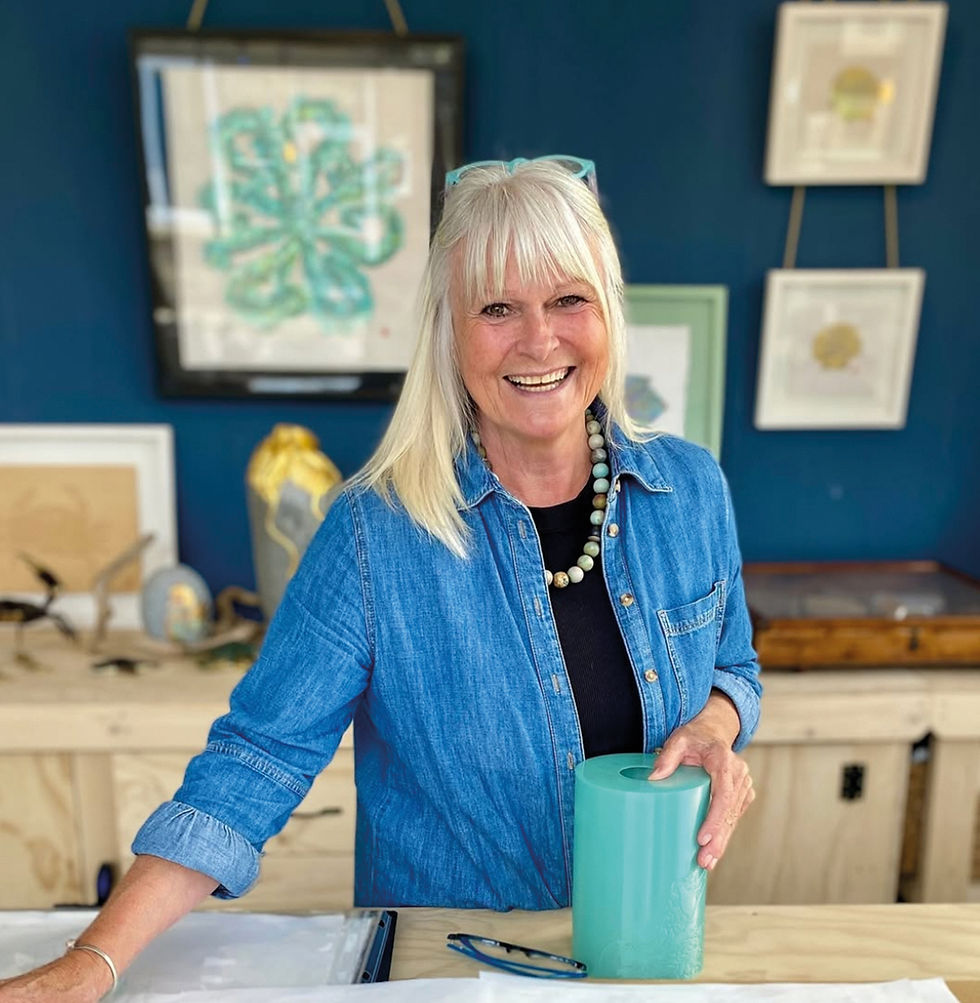
Returning visitors regularly drop in to discover what Stevie is working on next. Many arrive through recommendation, bringing friends and family with them. Others stumble upon the gallery by chance and find themselves drawn into conversations that weave together fishing heritage, environmental awareness, design, food, art and imagination.
Stevie laughs that she is “far too noisy to run a quiet gallery,” and perhaps that is part of its appeal. This is not a place where artwork hangs silently on the walls. It is an immersive experience. Every object has a story. Every fish has a journey. Every corner reveals another layer of creativity waiting to be discovered. Even her guest artists have to fit into her ethos of knowing where something has come from, what impact it has had and continues to have on the earth. That same passion extends beyond the gallery through workshops and educational school projects, where children are encouraged to engage directly with materials, texture and storytelling. Through touch, observation and curiosity, they are invited to think differently about creativity, sustainability and the natural world around them.

The public profile of Stevie’s work continues to grow. Being selected as this year’s artist for the Penzance Promenade and town centre flags project has brought her imagery into the public realm on an unprecedented scale, and in doing so has introduced thousands of people to her intricate work and its unique underlying narrative. Looking ahead, the possibilities seem to be almost limitless.Interiors, furniture, textiles, immersive installations and collaborative projects all sit firmly on the horizon. There is even the possibility of television, bringing the stories behind the work to wider audiences.
Top Left: Preparation |Above: Filling in the detail | Top Right: Stevie’s flag on the promenade in Penzance
Yet whatever direction the journey takes, the starting point remains the same. A fish. A story. And one small gallery in Newlyn, modestly proving that the most extraordinary ideas can emerge from the most unexpected places.


