Method and Memory
Words by Jamie Crocker
The creative force behind Alchemy Tiles inhabits a world informed by the supple compliance of her chosen material and a centuries-old technique.

Mel Chambers is that force. But before delving further, it is worth pausing to consider the history and technique that underpin this craft. Carving its way along ancient paths, from the 13th century onwards, through France, across the channel and into England, the art of encaustic tile making has had mixed fortunes. Favoured as a form of practical embellishment, no church, monastery or palace could open its doors without relying upon their colourful and intricate designs to bring a space to life. However, as the heady enthusiasm of the Renaissance waned, so did interest in this form of interior enhancement, particularly in this country, partly due to the dissolution of the monasteries. It wasn’t until the Victorian era, and the subsequent Gothic revival that heralded renewed interest in all things medieval, that encaustic tile making reached the height of its popularity. This fascination with a halcyon past was a reaction against the industrialisation, urbanisation and social changes of the 19th century. Victorians frequently contrasted their ‘modern’ world, seen as dirty, rational, and materialistic, with a romanticised image of the medieval period as spiritual, beautiful and authentic. Led by figures such as William Morris and John Ruskin, there was an advocacy for a return to handcrafted goods and the ‘freedom’ of the medieval craftsman, a rejection of mass-produced and machine-made goods.
So, what is encaustic tile making? The name ‘encaustic’ comes from the Greek word enkaustikos, meaning ‘to burn in,’ which refers to the process of heating and setting the coloured clays into the tile’s surface. Traditional encaustic tiles made entirely from clay use an inlay method rather than surface decoration. A base tile is created, and while it is still leather-hard, its surface is stamped or impressed with a carved design to create shallow recesses. A contrasting liquid clay, or slip, is then pressed into these recesses, and the excess is scraped away so the pattern remains only where it was impressed. The tile is then dried carefully to prevent distortion. Once dry, the tile is fired in a kiln to harden it, and in many cases, finished with a clear glaze and fired again. Because the pattern is physically inlaid into the body of the tile, it does not wear off like a surface print.

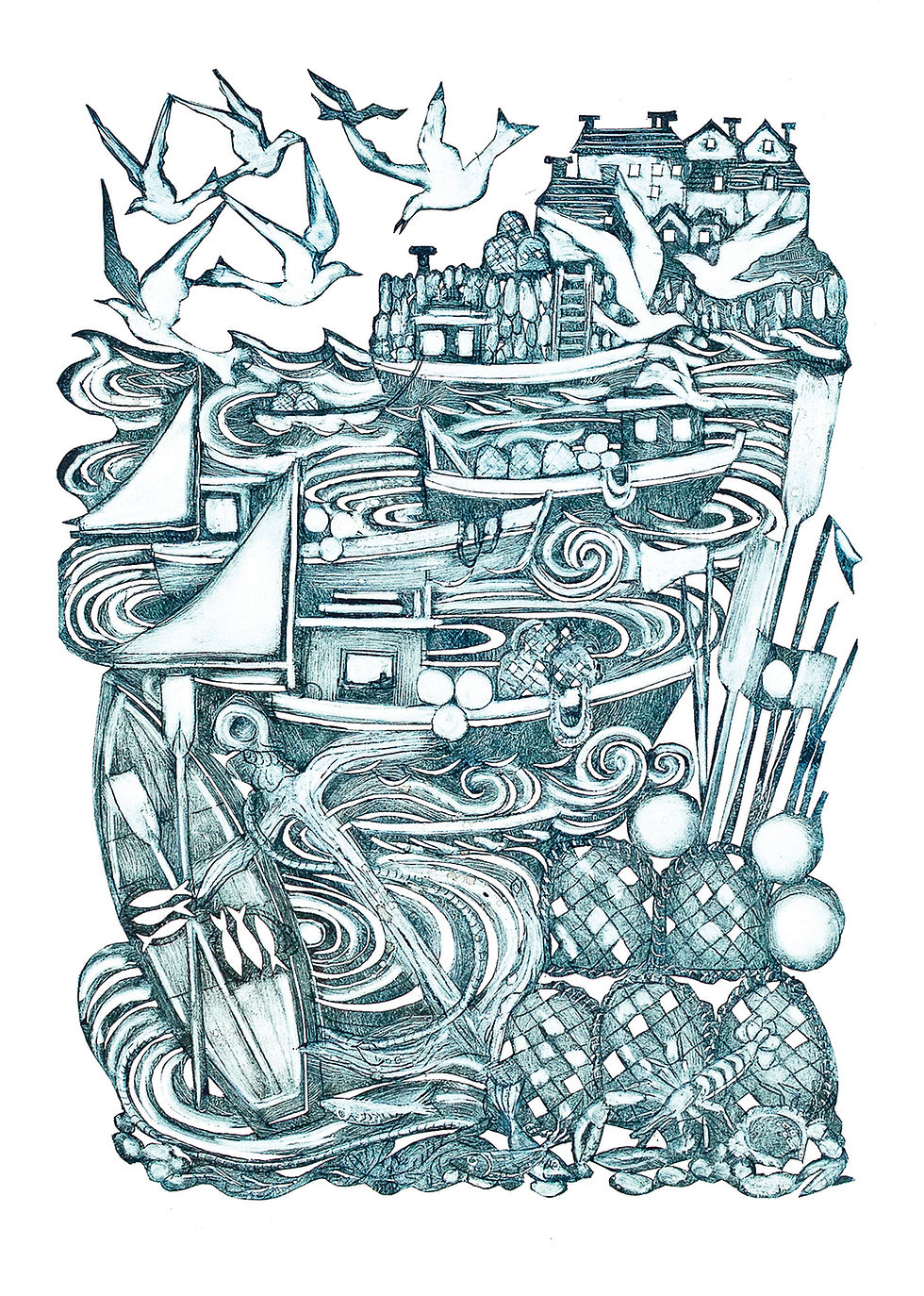
Mel’s work, however, diverges from this traditional mould-and-stamp method. Rather than relying upon templates or repeated forms, she carves directly into wet clay completely freehand, cutting both pattern and tile shape by hand. It is a painstaking process that allows complete freedom of design, colour and layout, unrestricted by standardised dimensions or pre-existing moulds. The result is that no two pieces can ever be exactly replicated, even if she wished them to be. So although she works within the inlay tradition, one that retains clear relevance as interiors move away from standardised finishes and return to materials that show evidence of making, her approach makes her the only practitioner working in such an instinctive and highly individual way, where the hand remains visible in every line, contour and incision. As she says, “What dilutes craft is when it becomes mass-produced and highly manufactured, when it follows a trend only to be forgotten. My work is rooted in something much slower and more enduring.”
Her tiles connect historical reference with present-day use, while the character of clay, oxides and stains shifts with sourcing and is absorbed into the process, adding to the individuality of each piece she creates.
Every commission begins with a client narrative, where listening precedes carving and form develops through dialogue, drawing upon place, memory or association, which Mel interprets into carved surfaces where personal detail sits alongside a wider reference. The clay records gesture and toolmark, so meaning is carried not only through image but through the act of making itself. “Just like the clay, the story reveals itself over time. My role is to honour that, to create something that feels true to the person, the memory, or the moment it represents. By the time the piece is finished, it holds more than an image or a design. It holds a presence. Something that can be lived with, remembered, and returned to over time.”
Material decisions follow permaculture principles of ‘earth care, people care and fair share,’ with traceable sourcing, reuse and waste reduction built into studio routines. Environmental impact is treated as an ongoing consideration, with emphasis placed on durability and long-term use.
The installation of what she produces remains integral to the practice, with Mel overseeing layout from initial drawing to final placement, accounting for sockets, edges and structural interruptions as part of the design. Consideration of grout, sealant and junctions runs alongside carving, allowing the work to resolve itself within the building as a continuous surface.
Encaustic tiles have found a confident place in contemporary interiors, valued for their durability and individual graphic clarity. In kitchens, they are ideal for splashbacks, where pattern can offset pared-back cabinetry and modern fittings. Bathrooms benefit from their water resistance, with tiles bringing structure to floors, shower enclosures and vanity surrounds. Living areas adopt them more sparingly: a fireplace facing, a section of floor, or a feature wall that introduces a focal point without overwhelming a room. What story would your tiles tell?