

Within the fabric
- Feb 27
- 5 min read
Words by Jamie Crocker
Intelligent home technology – integrated early and supported fully.

At some point during the build of a house, someone will stand in an immaculate, newly plastered room and ask where the cables are meant to go. It is usually at that moment that the cost of leaving technology until the end becomes painfully clear. Walls are chased, ceilings opened, and that dream home is never the same again. Barton Automation prefers never to attend that meeting.
The company, led by brothers Joe and Josh Harvey, operates from Kingsbridge in South Devon, serving clients across the South West and in London. Founded by Joe in 2008, just as the financial crisis tightened its grip, the business grew from early residential audio and visual installations into a specialist in custom electronic design and integration. Josh joined in 2013 after completing a business degree, and the firm now employs a team of ten. What began with televisions and speakers has developed into something more embedded: technology conceived as part of the building rather than applied to it.

The distinction matters. In high-value new builds and substantial renovations, Barton Automation is often engaged alongside architects and interior designers at the earliest stages. That shift has not happened by accident. The brothers are members of CEDIA, the Custom Electronic Design and Installation Association, whose recent industry focus has been on closer collaboration with design professionals. Through continuing professional development presentations, Barton Automation elucidates to architects and interior designers the practical implications of smart home systems: cabling routes, ceiling voids, plant room space, structural supports for large displays, and recesses for motorised blinds. These are construction details, not contrary afterthoughts, and they demand addressing from the get-go.
In Devon, much of their work is driven by private clients building primary or second homes. And, somewhat against the usual flow, what happens in the West Country segues into London, where Barton Automation are picking up business through a reputation honed in Devon. A common factor is that the starting point of conversations begins much earlier than they once did. A modern house of scale cannot function on a single broadband router tucked under the stairs. Distributed Wi-Fi, lighting control, automated shading, door entry, whole-home audio and media systems require coordinated planning. Increasingly, so too does energy management.
One of the more significant developments in Barton Automation’s portfolio is the integration of building management systems. Rather than simply allowing a client to adjust heating schedules from a tablet or smartphone, the company is working with data from solar panels, battery storage, ground source heat pumps and conventional boilers to influence how a property consumes and stores energy. If the forecast is favourable and battery levels are high, the house may draw primarily on solar generation. In colder conditions, it may switch to a gas boiler, informed by prevailing energy prices. The aim is certainly not complexity for its own sake, but a more efficient response to conditions beyond the front door.


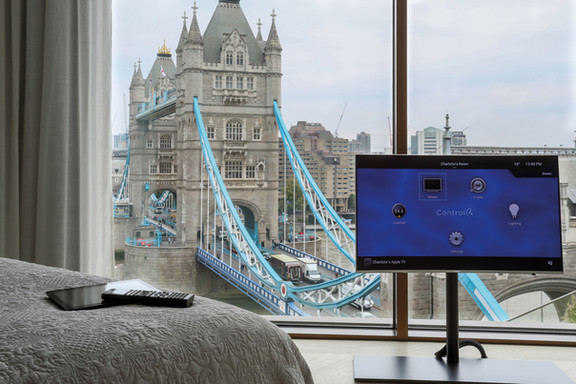
Above: Discreet technology integration enhances every room with intuitive, hidden control systems.
That principle runs through the company’s approach. Technology must simplify life, not complicate it. Josh Harvey is candid about the industry’s earlier missteps, when systems were over-engineered and unreliable. Clients would return home, attempt a straightforward task and find themselves wrestling with a wall-mounted control panel. Barton Automation now works to a model of intuitive interaction for the user. Systems are selected and configured to follow the path of least resistance, avoiding convoluted chains of triggers and commands. If an operation cannot be made obvious, it is reconsidered.
The aesthetic dimension is equally important. Interior designers are tasked with creating rooms that feel composed and personal; a black rectangle dominating a fireplace can undermine that effort. Concealment has therefore become a recurring theme. Artwork that parts to reveal a television, screens that rise from cabinetry or arise from floors, projectors paired with discreetly housed screens: these solutions allow a space to serve multiple functions without permanent visual intrusion. Motorised blinds can be recessed into ceiling pockets so that, when raised, only a narrow slot remains visible. Such details require decisions to be taken before windows are even ordered.
Behind the finishes, infrastructure is paramount. Cabling is installed with an eye to future demands, acknowledging that families and technologies evolve. A playroom may one day become a cinema room; a child’s bedroom may require data provision for study or gaming. Display standards change, bandwidth requirements increase, and equipment is replaced. By ensuring that appropriate conduits and cable specifications are in place from the outset, the company allows properties to adapt without repeated disruption and defacement.
The work does not conclude at handover. In larger projects, installation may occupy only the final weeks of a build that has spanned months. Once the keys are passed over, Barton Automation’s involvement often continues through maintenance packages. Connected homes are subject to software updates, hardware failures and network changes. The company monitors systems remotely, receiving alerts if an amplifier drops offline or a network device stops communicating. For clients, this offers reassurance; for the business, it provides recurring revenue that underpins long-term service.


Security features are handled with similar pragmatism. Holiday properties can be placed into occupancy simulation modes that replicate lighting and shading patterns based on recorded behaviour rather than fixed timers. The effect is subtle but mirrors real-time living, deterring any would-be intruder. Activation and deactivation are managed through straightforward controls, designed so that owners need not concern themselves with technical processes.
Professional standards underpin the operation. Through CEDIA accreditation and City & Guilds qualifications, the industry is moving towards clearer benchmarks of competence. While not a statutory requirement, affiliation signals adherence to recognised practices and ongoing training. For architects and interior designers navigating increasingly complex projects, that assurance carries weight.
What emerges from a conversation with Josh is less a fascination with gadgets than an insistence on planning. Budgets illustrate the point. A provisional allowance for “AV” in a building schedule may bear little resemblance to a client’s eventual aspirations once whole-home integration, lighting control and energy management are discussed. Early engagement prevents financial surprises and allows for realistic expectations.
For those commissioning significant residential projects, the lesson is plain. Intelligent home systems are no longer decorative add-ons; they influence structure along with spatial planning. When addressed at the correct moment, they recede into the background, supporting daily life without clamour.
Barton Automation has built its reputation on ensuring professional and seamless integration of AV installations through engagement with all parties. It is a disciplined approach in a field that, up until recently, has seemed fragmented. In properties where views are prized and interiors carefully designed, that discipline, like a soundtrack to a great film, is allowed to disappear into the background. Without it, however, there would be a notable absence.


