

Wellness by design
- Jan 26
- 5 min read
Words by Jamie Crocker
Ashton House Design reinvents Sandy Cove’s spa through collaboration and attention to detail.
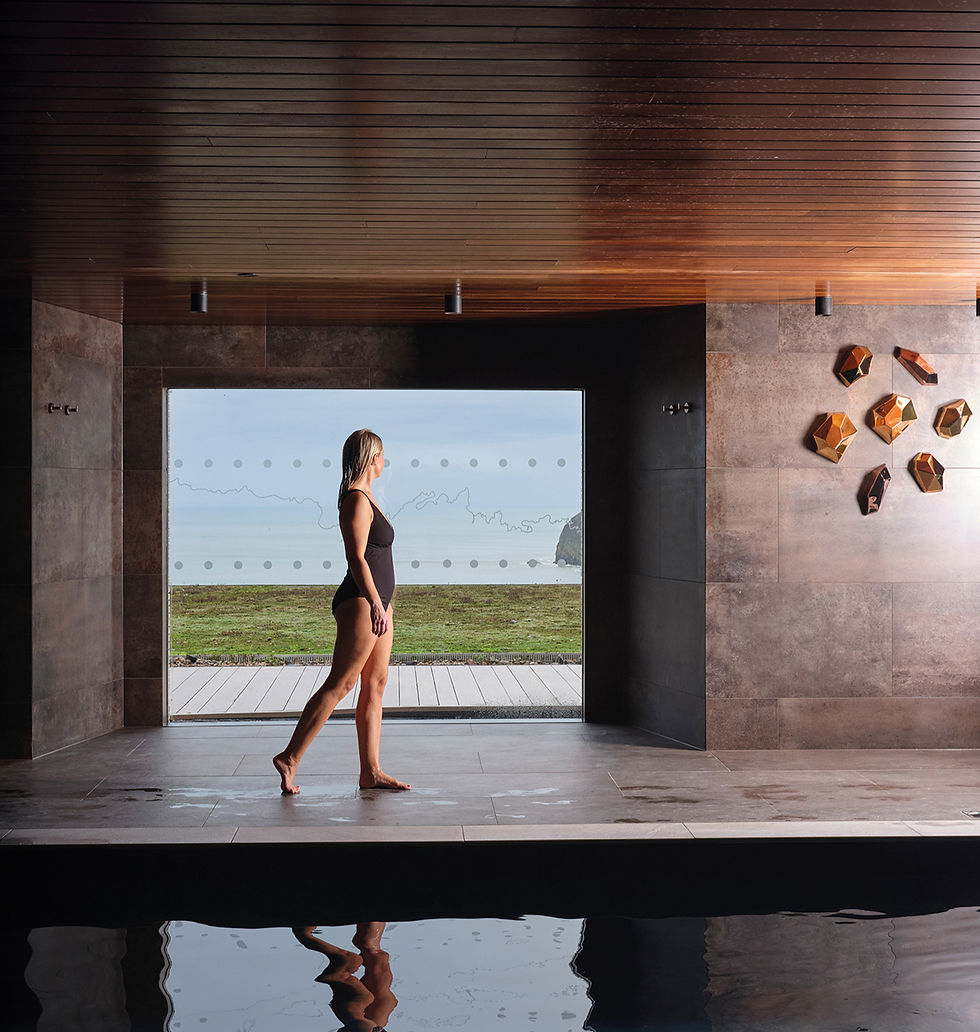
Sandy Cove Hotel is a family-run hotel perched on the dramatic North Devon coastline with far-reaching views out to sea. When the family decided to rework their spa, the brief was to create something with enduring appeal. The hotel, long established as a wedding venue and coastal retreat, wanted facilities that would carry the business forward. Ashton House Design, the Devon-based interior design studio led by Simon Bantock and Caroline Palk, was brought in not to perform a makeover, but to rethink how the space functioned and felt.
The studio’s experience and success with spa projects are well established. As Simon explains, they typically arise when a client is willing to pursue meaningful, structural change rather than superficial updates. Spas bring their own set of challenges: high levels of footfall, chemically harsh conditions, persistent heat and humidity and the need to create an atmosphere that feels welcoming rather than clinical. For Ashton House Design, they also provide an opportunity to explore ideas and scale that are less common in residential settings.
Sandy Cove already had an existing swimming pool and a set of changing rooms – but neither met the aspirations and ambitions of the owners. The wider project was broken down into two manageable parts. Phase One would address the pool hall, new changing facilities and reception – while Phase Two, now underway, will introduce treatment rooms, outdoor facilities and a garden linking to the wooded coastline beyond the hotel grounds. From the outset, Ashton House Design’s involvement extended well beyond interior finishes. The studio worked from the building envelope, rethinking layouts, circulation and the architectural shaping of the pool hall itself.

One of the most significant early decisions was to reposition the sauna and steam room so that they face directly onto the pool, rather than being hidden away within the changing areas. This required extending the pool wall and reshaping it architecturally, allowing these elements to become part of the main spatial experience rather than ancillary rooms. It also introduced a sense of visual depth, drama and activity within the pool hall – something the client had been keen to achieve. From the outset, the selection of materials alone set the tone for what was to follow – a scheme of depth and maturity that will endure.
Simon is candid about how many spa environments fall short, despite significant investment. Walls are built, systems installed, tiles chosen, yet the finished result can feel flat or discordant. At Sandy Cove, the aim was coherence rather than excess, incorporating layers of interest. Every surface, material and fitting selected by the studio revolved around an emphasis on durability and aesthetic consistency. Lighting design, often treated as an afterthought, was integral from the beginning, shaping how materials read and how spaces are perceived throughout the day.
In the changing areas, Ashton House Design took the unusual step of removing windows entirely and turning them into a subterranean space. This was not done to deny a connection to the outside, but to control the environment fully. By creating a space unaffected by daylight, the studio could ensure that the atmosphere remains constant, whether on a bright summer afternoon or a winter evening. This theatrical approach required careful explanation, but the client embraced the rationale once the implications were understood. The result is a setting where light, tone and reflection are deliberate and mesmeric.




Material choice was central to achieving this control. The palette leans toward dark, bronzed and warm tones, without taking the lazy option of resorting to black. Tiles were selected not only for colour but for how they respond to light, revealing warmth rather than appearing flat. In the pool hall, the studio expanded the glazing along one elevation, pushing the building out to create a series of castellated sea-facing lounging bays. These replaced what had previously been a flat glazed elevation, and afforded the opportunity of tiling throughout and the installation of artwork sourced in Paris. These pieces, metallic in appearance but ceramic in composition, catch and reflect light while remaining suitable for a corrosive poolside environment.
Texture and layering recur throughout the scheme. In the mixed-use changing area, a chain-mail curtain partially screens the space beyond the entrance, softening the transition without resorting to full visual barriers. Such subtleties were important given the shared nature of the facility. Ashton House Design has experience designing spaces that need to be inclusive without feeling generic, and here the solution avoids overt signals in favour of gradual disclosure. All of the furniture within the spa was designed by the studio and made to order.
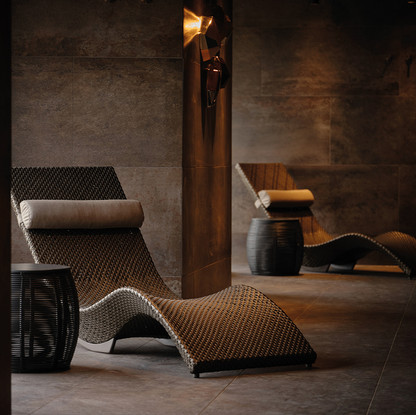
Upholstered seating uses fabrics developed for marine and yacht interiors, chosen for resilience as much as comfort. Angular stitching patterns reference the North Devon coastline in abstract form, a restrained nod to context rather than a literal one. Elsewhere, a compressed black cork bench provides robust, tactile seating that is forgiving in a wet environment. Its form borrows from structural elements seen on building sites – both practical and humorous.


The mirrors and vanity zones in the changing rooms serve both practical and spatial roles. One large mirror at the end of the room, framed with light, reflects the area and amplifies the scale of the space. Shower doors are treated not as a line of functional openings but as part of the visual field, with high-resolution photographic imagery applied to glass panels and backlit from within the cubicles. The images, drawn from the coastline near Ilfracombe, provide visual interest as well as addressing the eternal problem of ending up with a room that resembles a corridor of doors.
Underlying these decisions is a working method that places collaboration and anticipation at its centre. Ashton House Design presents clients with drawings that explain circulation and layout before moving on to share physical samples and materials. This layered presentation allows discussion to focus on the rationale aligned with preferences. The studio also challenges its own ideas in-house, anticipating questions from contractors and resolving technical concerns before they become an issue on-site. This approach builds confidence among the wider project team and reduces friction during construction.
The Sandy Cove project brought together a broad group of contributors who were closely involved in the business on a day-to-day basis. That level of engagement, Simon notes, makes a significant difference. The family’s enthusiasm for the outcome fed back into the design process, even when the project encountered the inevitable constraints of site and planning. The land itself dictated what could be built and where, particularly as future phases extend toward the sloping woodland and shoreline.
For Sandy Cove, the redesigned spa complements their established wedding venue business whilst appealing to a wide demographic. Guests often arrive with time to use the facilities and share their experience, making the quality of the environment as important as the services offered. Ashton House Design’s contribution lies in recognising that differentiation comes not from adding more, but from making deliberate choices that synergise rather than working against each other.
It reflects a belief shared by both client and designer: that well-resolved spaces require thought and conversation.


