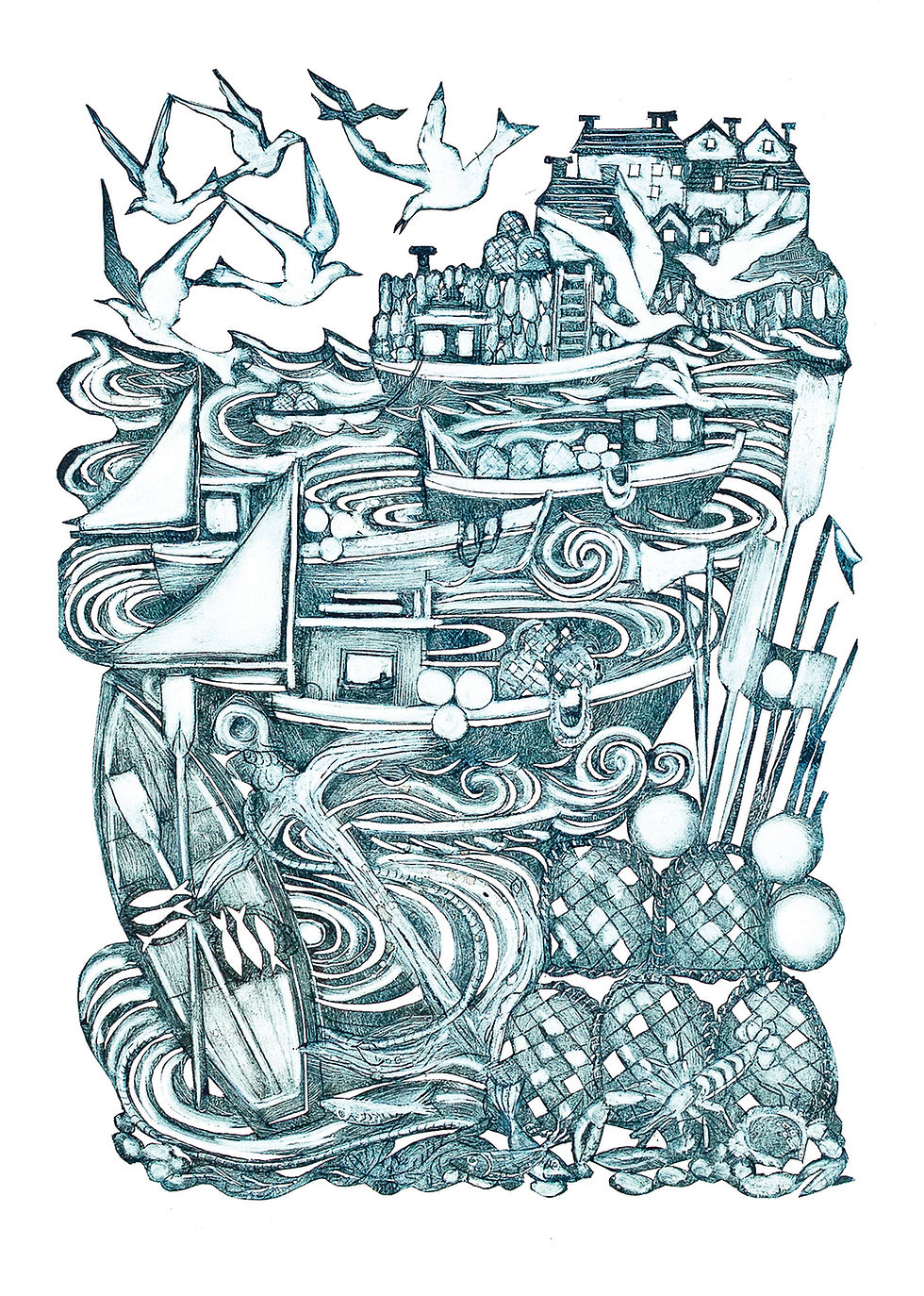
Manifest Destiny
Words by Lucy Studley | Images by Gavan Goulder
Artist Vicki Norman’s journey follows in the footsteps of her artistic forebears on the Cornish coast.

Sometimes, the stars align. As an eight-year-old girl, Vicki Norman visited Newlyn with her mum, who purchased a book about the work of the Newlyn School group of artists. Unbeknown to her, in the very pages of this book Vicki’s future was laid out; she would train to be an oil painter, move to Newlyn, learn to sail traditional luggers, and become custodian of a unique piece of art history, namely a studio behind Gwavas House where the pioneers of the Newlyn art colony created many of their famous works. Now Vicki’s own work is the subject of the summer exhibition at the hotel, The Old Coastguard, in Mousehole, raising money for the Cornish Maritime Trust of which she is Artist in Residence.
Vicki’s story is worthy of a book in its own right, but the humble studio at its heart has ‘main character energy’, so we’ll start there. Climbing the steep stairs to this old net loft and pushing open the wooden door inscribed with years of fishermen’s graffiti, makes the hairs on the back of your neck stand up.

When Vicki began restoring it, spontaneous little paintings and sketches were discovered underneath lengths of linen lining a wall, some of which have been removed and sent away for conservation. It’s easy to imagine a succession of painters occupying this humble and homely little garret, their lives and work entwined with the fishing community around them. The sense of history is palpable, even the dust motes circulate with the muted pigments of the Newlyn School. Newlyn has a long history as an important fishing port. In the 1880s it began to attract artists in the same way St Ives did in the inter-war period, but this earlier Newlyn art colony was firmly rooted in representation rather than landscape-based abstraction. The artists, many of whom had trained and worked in Brittany, Paris and Antwerp, were committed to portraying the lives of the fishing community, finding beauty in their strong characters, their trials and tribulations, and their rustic living conditions. Was there an element of romanticising poverty? Sure. But the best of the Newlyn School works, many of which reside at Penlee House in Penzance, are rich with pathos and painterly skill.
The artists lived amongst the coastal community they painted, renting cheap rooms, often net lofts, to live and paint in. Gwavas House, whose maritime inhabitants would have hauled their boats and catch up the shore from Sandy Cove just below, was one such space. Vicki has researched the history of the studio where she now works extensively and knows it was rented long-term by the painter Thomas Cooper Gotch. Walter Langley and Stanhope Forbes also stayed and worked there, although Forbes only briefly.
Top Right: Fishermen’s grafitti | Above: Gwavas House Studio
Several studies and paintings show members of the family who owned Gwavas House and depict the linhay beneath the studio, including Walter Langley’s Local Critics, which shows a couple looking at a painting placed on an easel in the yard.
On a serendipitous holiday to west Cornwall Vicki, an established oil painter who lived in Shropshire at the time, discovered the house and studio for sale. Having always been in the same family, the connections back to the heyday of the Newlyn art colony were maintained through oral history as well as in the local archives, although the studio itself had long fallen out of use.
It nearly slipped through her fingers but eventually Vicki and her partner Mark Branigan had an offer accepted, and the painstaking restoration of the house and studio began.
This precious piece of art history could not have fallen into better hands. Although actively discouraged from devoting herself to traditional painting techniques at art school, Vicki has always been a devotee of a timeless, painterly style and traditional subjects, influenced no doubt by that early trip to Newlyn and the prints which hung on the walls of the family home as a result.
Above: Gwavas House Studio
For Vicki, the precision of composition techniques and colour theory were things to be rigorously explored and applied, rather than rushed through enroute to abstraction or conceptualism. She eschewed more contemporary styles of painting, favouring an impressionistic approach and skill set which had its heyday around the turn of the 20th century, but to call her work ‘old fashioned’ is to do it a massive injustice; timeless and rooted in rare accomplishment would be more accurate.
“The 1880s to 1910s is the era of painting that really moves me,” explains Vicki. In choosing to focus on composition and colour theory, painting en plein air, and using historic pigments, she is working with the same principles as the Newlyn School artists and their contemporaries across Europe. As she puts it: “Working on location quickly to capture the essence of a time and place encourages a looser, more impressionist style of painting which focuses on atmosphere above detail. Restricting the use of pigments to specific parts of the colour wheel gives a softness and historic quality to the work, but it also amplifies the light and mood of each painting – it’s that feeling of things clicking into place. This balance and quietude is my painterly voice, it’s how I see the world.”

How Vicki sees the world has also been informed by her love of sailing, a passion she is now able to indulge regularly as Artist in Residence for the Cornish Maritime Trust, a charity which helps preserve Cornwall’s maritime heritage
by maintaining and sailing historic working vessels. This includes the iconic red-sailed lugger Barnabas which, built in 1881, is the oldest mackerel driver still sailing today.
In order to paint these boats on the Cornish coast, and indeed to paint from the boats themselves, Vicki has had to become an adept sailor. It’s something she has a natural affinity for and some of her happiest memories are of sailing with her dad when little. “Being at sea is wonderful creative fuel for a painter like me,” she explains. “For a start you get an entirely different view of the coastline, and you feel so much closer to the raw elements. When I’m sailing, I’m physically in the kind of liminal spaces I’m trying to represent on the canvas, where land meets sea, and sea meets sky.”

Maintenance of these heritage vessels is an enormous undertaking and something all the Trust’s volunteers work incredibly hard on, preserving endangered skills and passing them to the next generation. In learning these skills, Vicki has become familiar with the ‘anatomy’ of traditional luggers, which in turn informs her work. It’s a process not dissimilar to the dissection training of a Renaissance painter, only without the gore.
This summer’s show at The Old Coastguard in Mousehole curated by Penzance-based Artist Curator, Gillian Cooper, is raising money for The Cornish Maritime Trust, with a percentage of sales going to the charity. Aptly entitled Colourful Sails, Ripples of Light, the collection of works featuring the majestic traditional boats and timeless coastal scenes will be perfectly at home on the walls of this colourful and comfortable inn by the sea, where the sight of red sails passing by is cherished.
Above: Vicki has been gradually restoring Gwavas House while retaining its historical atmosphere
Charles Inkin, Co-Owner of The Old Coastguard, said: “Vicki’s mesmeric work is the perfect subject for a summer exhibition here in Mousehole. Whenever the red sails of Barnabas are seen from the terrace or garden, there’s a momentary collective pause. It’s like the past sailing reassuringly into view for a moment. We’re very glad to be able to support the Cornish Maritime Trust, and I’m looking forward to seeing Vicki’s work in situ.”
Colourful Sails, Ripples of Light is at The Old Coastguard until July 6th.
Vicki will be holding a Meet the Artist event on Thursday 2nd July, and her work will be exhibited throughout the summer.