

Designing and building responsibly
Words by Jamie Crocker
ARCO2 Architects integrates design and construction through low-energy delivery systems.

Projects rarely begin these days with a blank page. They start with a conversation about performance, materials and the realities of building in exposed parts of Cornwall. Heat loss, air tightness, ventilation, salt carried on the wind and the constraints of designated landscapes all enter the discussion early, alongside how a building will be used day to day. For ARCO2 Architects, that early exchange acts as the anchor, shaping a design that is carried through by the same team from first briefing to handover.
ARCO2 Architects began operating in 2003 with a clear direction towards sustainable, low-energy design. At that point, the technical demands of such work were already well understood within specialist circles, though less widely adopted across the broader residential market. From the outset, the practice focused on reducing operational energy demand, improving building performance and addressing the environmental impact of construction within Cornwall’s exposed coastal conditions. That emphasis has remained consistent, even as the tools, systems and expectations around sustainable building have developed.
Over time, Passive House methodology became embedded in the practice’s approach. It now forms the basis for the majority of projects, shaping decisions around insulation levels, airtightness, ventilation and energy systems. Three certified Passive House designers sit within the team, reinforcing a shared understanding of performance targets and delivery methods. Buildings are conceived as complete environmental systems, where fabric performance, mechanical systems and renewable technologies operate together to deliver predictable outcomes in use. The practice has received more than 110 awards, including national recognition, though scale has remained measured.
The architectural team operates alongside a construction arm that delivers a focused number of projects each year, typically one or two, occasionally three. This pace reflects the level of involvement carried through each scheme. Projects are taken from initial discussion through to completion, with continuity maintained by a consistent team structure.
In 2016, the practice established ADD Sustainable Construction Ltd to bring design and delivery into a single workflow. This step followed earlier experience working with external contractors, where achieving the required levels of airtightness, insulation continuity and detailing demanded close coordination.
By forming an in-house construction company, the practice created a route through which design intent could be delivered with greater precision on site. Architects, project managers, site managers and quantity surveyors operate within the same framework, maintaining clarity of information from first sketch through to handover.
Top: Keynvor in Mawgan Porth (available to rent via Unique Homestays) | Above: Highcove in Mawgan Porth
Technical decisions carry through this process without dilution. High levels of insulation, continuous airtight layers, triple glazing and mechanical ventilation with heat recovery are standard across projects. Renewable energy systems, including air source and ground source heat pumps, photovoltaic panels and battery storage, form part of an integrated strategy aimed at achieving very low energy use in operation. These elements are not treated as additions; they are resolved as part of the initial concept and developed alongside the architecture.
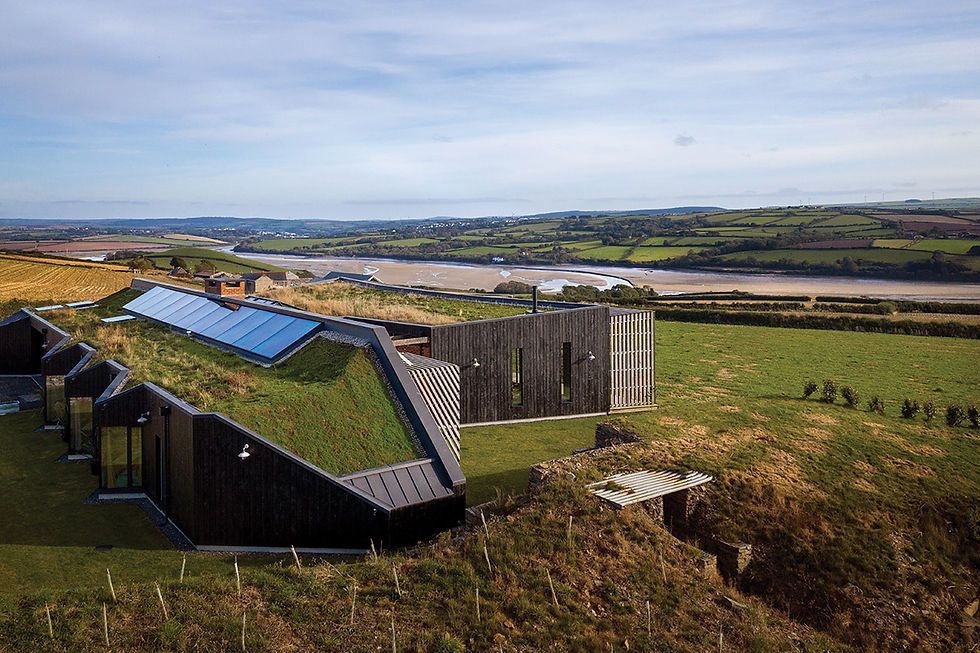
The practice works predominantly within Cornwall, with occasional projects beyond the Tamar. Its location allows close engagement with sites that present a wide range of environmental conditions.
Coastal areas bring exposure to wind, driving rain and salt carried in the air. Inland locations introduce different considerations, including shelter, vegetation and microclimates that shift across short distances. This variation informs design decisions from the outset, influencing orientation, form, material selection and construction detailing.
Many sites fall within designated landscapes, including Areas of Outstanding Natural Beauty and locations with specific environmental protections. These designations introduce a layer of scrutiny that extends beyond technical performance. Buildings are assessed for their visual presence within the landscape, often across long distances and from multiple viewpoints. The practice approaches this through careful consideration of massing, proportion and material, ensuring that each building occupies its position in harmony with its surroundings.
Form and material are resolved with that visibility in mind. Proportions draw on familiar building types within the region, while detailing reflects current construction methods and performance requirements. Materials are selected for durability and maintenance cycles, ensuring that buildings retain their integrity over time under demanding conditions. Particular attention is given to the effects of salt exposure on fixings, finishes and external surfaces, with specifications developed to support long-term performance.
Projects including Sandunes, Edge O Cliff and Reflections at Portwrinkle demonstrate this approach across varied contexts. Each responds directly to its site, with attention given to orientation, shelter, and the management of internal environmental conditions. Openings are positioned to balance daylight, heat gain and views, while the building envelope maintains consistent performance across seasons. These projects illustrate a method of working where architectural decisions are closely aligned with environmental performance.
The practice maintains a clear position on architectural language. Regional identity is addressed through proportion, material and response to landscape rather than replication of historic forms.
Top: Waterhouse (known as the original Omaze house) and Portwrinkle (available to rent via Unique Homestays) | Above: Sandunes, Mawgan Porth
New work is developed as part of an ongoing architectural record, where each addition can be understood within its own time while maintaining continuity with its surroundings. This position reflects a broader view of architecture as a cumulative process, where buildings contribute to a shared environment over extended periods.
Much of the firm’s work involves replacement dwellings and substantial refurbishments. These projects often arise in locations where existing buildings carry limited energy performance and where redevelopment offers an opportunity to improve both efficiency and longevity. Clients typically arrive with a clear understanding of sustainable construction, seeking buildings that align with long-term environmental and operational goals.
In some cases, this reflects established ways of living; in others, it represents an aspiration towards a different approach to energy use and domestic comfort.
The residential market in Cornwall introduces specific economic conditions. Land values and construction costs influence the feasibility of projects, shaping decisions from the earliest stages.
The practice operates within these parameters, focusing on delivering buildings that maintain performance standards while responding to financial realities. The question of affordability remains complex within the county, particularly in relation to housing supply and demand, and forms part of the wider context in which the practice works.
Earlier in its development, the practice engaged across a broader range of sectors, including education, community projects and affordable housing.
Over time, it concentrated its efforts within the residential sector, where project structures allow for greater design input and more detailed development of proposals. This shift enabled the team to dedicate the necessary time to resolve buildings thoroughly, aligning design ambition with construction delivery.
Standardised approaches to housing design often produce environments with limited reference to local conditions or architectural character. Within its own work, the practice focuses on reinforcing regional distinctiveness through considered design decisions, supported by current construction technology and environmental understanding.
Top: Furzy in Polzeath | Above: Ladybird Farm, St.Tudy
The office itself reflects many of these principles. Converted in the early years of the practice, it incorporates natural insulation materials, breathable construction methods and plant-based finishes. Sheep’s wool insulation and recycled components form part of the building fabric, alongside natural oils and low-impact products used in finishes. Over time, the space has evolved, incorporating planting that contributes to air quality and internal conditions. A mature passion flower extends through the building, forming part of the everyday environment in which the team works.
Training and development form an ongoing part of the practice’s work. Students regularly join the office for placements, gaining experience across design and construction stages. A number have progressed into architectural careers, returning to the practice in professional roles. This continuity supports a working culture where knowledge is shared through direct involvement in projects, with an emphasis on understanding how buildings are realised as well as how they are designed.
The practice’s approach to project delivery reflects a broader view of architecture as a collaborative process. Structural engineers, consultants and specialist contractors contribute to each scheme, with coordination maintained throughout. Digital tools support this process, allowing detailed modelling and analysis at early stages, while site experience informs ongoing refinement during construction.
Across its portfolio, the practice maintains a consistent method. Each project develops through detailed attention to energy performance, material behaviour and site conditions. Decisions accumulate through this process, shaping buildings that operate effectively over time and within their specific environments.
The aim remains clear: to deliver architecture that performs as intended, supports its occupants and responds directly to the conditions in which it is built. In Cornwall, where landscapes carry both visual and environmental significance, this approach establishes a clear position. Buildings are designed to perform, to endure and to sit within their surroundings with considered presence. The work proceeds through careful calibration of design and construction, with each stage reinforcing the next.


