On a journey
- May 1
- 6 min read
Words by Hannah Tapping | Images by Linda Hermans
Nature-inspired cuisine with a focus on the landscapes, flora and fauna.

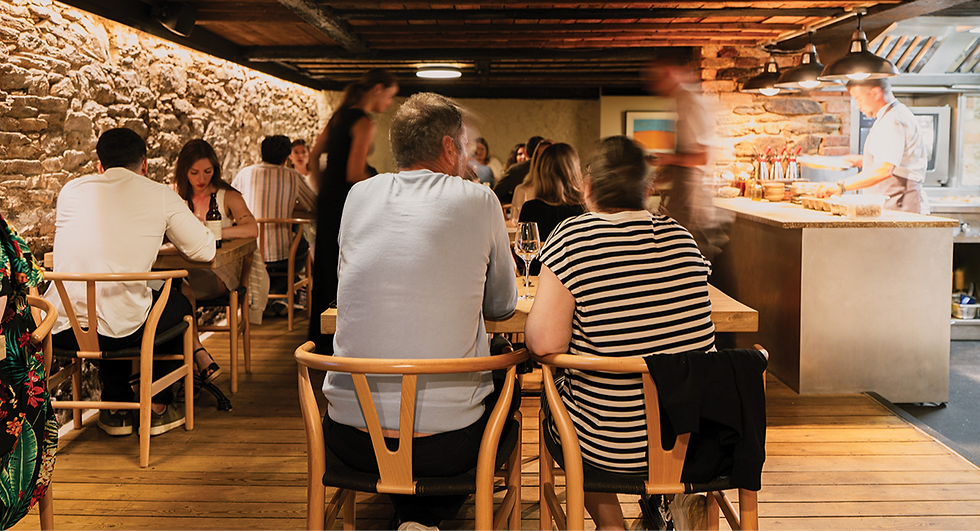
South African-born, Chef Patron Hylton Espey, along with wife Petronella, run Culture, a farm-to-table restaurant on Custom House Quay in Falmouth, with a tasting menu that changes almost daily. Ingredients are central to Culture in a way that is rarely so detailed or intentional. Whether that be foraging for seaweed and wild garlic on nearby clifftops, milling flour daily or ageing beef on site for up to 95 days, Hylton and Petronella pay homage to both the produce and its growers. In conversation with Hylton, we talk about their trusted suppliers and the part they play in the story behind every dish.
How would you describe Culture?
We have a focus on using suppliers who we are proud to know by name. We don’t really think about it in terms of food miles as we feel that the phrase can sometimes be misused as a cover-up for sourcing some things close by, but then others from far afield. We choose to be very restricted in how we do things at Culture. We opened the restaurant in July 2022 and, four years on, I am now able to create a full year’s menu just using local suppliers. The first year wasn’t easy as when you get to November and December, a lot of the guys have stopped growing. So, I thought, I’ll forage and see what I can get, and we managed to scrape through keeping to our ultra-local ethos.

We’ve met more suppliers since we opened the doors four years ago and now buy from farmers who still have produce in the ground right through the winter months, as well as those who stagger their growth throughout the year. I can now get beetroot from three different people, at three different times a year!
Can you walk me through the Culture experience and what a guest can expect?
Our lunch menu is five courses and our dinner menu seven, but with nine items. The first we call a ‘flurry of snacks’, which is essentially a relaxed version of a traditional amuse-bouche, but for sharing. Then each course on the menu is told as a chapter within the story, which might either be an experience we’ve had in Cornwall, or a tale of a producer and their approach. For example, last night we had monkfish that was caught by a Scottish langoustine boat that’s down fishing on the Isles of Scilly, so the fish course was named ‘Moving South’.
Do the menus change daily?
Almost daily… We keep the structure and the base story the same, but the flavour profile changes. For example, in the ‘flurry of snacks’ we have a cheese and onion churro, which last night had the first of the wild garlic in there for the onion flavour. The fish, one of the meat courses and the dessert can change quite often. We don’t follow the rules of a four-season menu change; rather we see what is available week on week and decide from there. Last week we had pork belly from Amelia and Chloe at Real Food Garden, Saturday lunch was beef from James at Footes Farm and Saturday dinner was lamb from Tresemple Farm.
How far in advance do you have to plan?
For beef, I have to order six months before the animal’s even left the field and then I age it myself for three months. So, that’s nine months in the planning. At the moment I’ve got Dexter beef, which we’ve aged for 95 days. The sirloin is so good at the moment. I remove the fat, render it down, then cook the sirloin in the beef fat, then finish it on the grill outside. And then with the bones, I create a beef jus for what we call our café au lait sauce. The stock is cooked down and finished with dried shiitake mushrooms, Alexander seeds and some cream before being served with the sirloin.
I know bread is very important to you, can you tell me more about this?
We buy our wheat whole from William’ at Cornish Golden Grains and I then stone-mill it fresh on the days I bake. The wheat is still very much alive when we buy it, so we’re baking bread with a living grain, which makes it special. We serve it after the flurry of snacks with a smoked butter on the side, and a drizzle of honey over the top from a single beehive on the Lizard.
The flavour profile of the honey is incredible, every time you open a new jar, it’s ever so slightly different. The beekeeper can actually tell me exactly which plants the bees have gone to looking at the pollen they bring in. For our latest one, I get the feeling they’d been on some gorse flowers, because it’s got a real tropical flavour to it. It’s this attention to detail that makes our dishes
so unique.
Can you talk me through the rest of the dishes, course by course?
Following the flurry of snacks and bread course we do an egg dish, either a hen’s egg or a duck egg. I try to use duck eggs as much as possible and I’ve been working with Roger and Tanya at Terras Farm for many years. The version we have on the menu at the moment is a duck egg yolk poached in a wild garlic butter, topped with puffed wheat and wood sorrel. When we get asparagus in the next couple of weeks we’ll add that with it too, but it will only appear on the menu for three out of four weeks, because we just use one farm. After the egg course comes Coastal Fields, which showcases potatoes. Where possible I get Cornish potatoes, and serve them with rock samphire, which I forage for, and then I make a baked potato foam that goes over the top, dusted with beurre noisette. This changes a little bit depending on the time of year; sometimes we’ll do Jerusalem artichoke, or make it more familiar with sage or rosemary. The rock samphire is coming back now, which is good and so are the nettles.
Then we have the fish course. At the moment it’s Moving South – the monkfish, poached in a little butter is finished on the ‘braai’ which is a South African barbecue. The charcoal I’m using at the moment is made from trees blown over during Storm Goretti, all from St Michael’s Mount, and as the buttery monkfish goes on the grill and the butter juices and fish caramelise, it has this quality that reminds me of a South African Saturday in Cape Town, barbecuing fish. The sauce is a seaweed butter, for which I forage three types of seaweed, dry them out, and then rehydrate them inside the fish stock.
The meat course is the sirloin from James’ Dexter beef, which are raised on a diet of field herbs. James’ chickens live in the field, happily scratching around, then he moves them to the next field and brings in his herd of Dexters. They eat all the weeds and the herbs that have grown there, and once they’ve moved through, the chickens come back and scratch away again, bringing life into the soil. When you work with the beef, there’s no yellowing of the fat, no corn substitute. It’s ready to use almost straight away really, but by ageing it we develop more of those amino acids and savoury notes, and it breaks down to be much more tender. We serve it with purple sprouting broccoli from Rhys, and mushrooms – lion’s mane or shiitake – all grown by Phae at A Taste of the Good Life in St Agnes.

How do your supplier relationships work?
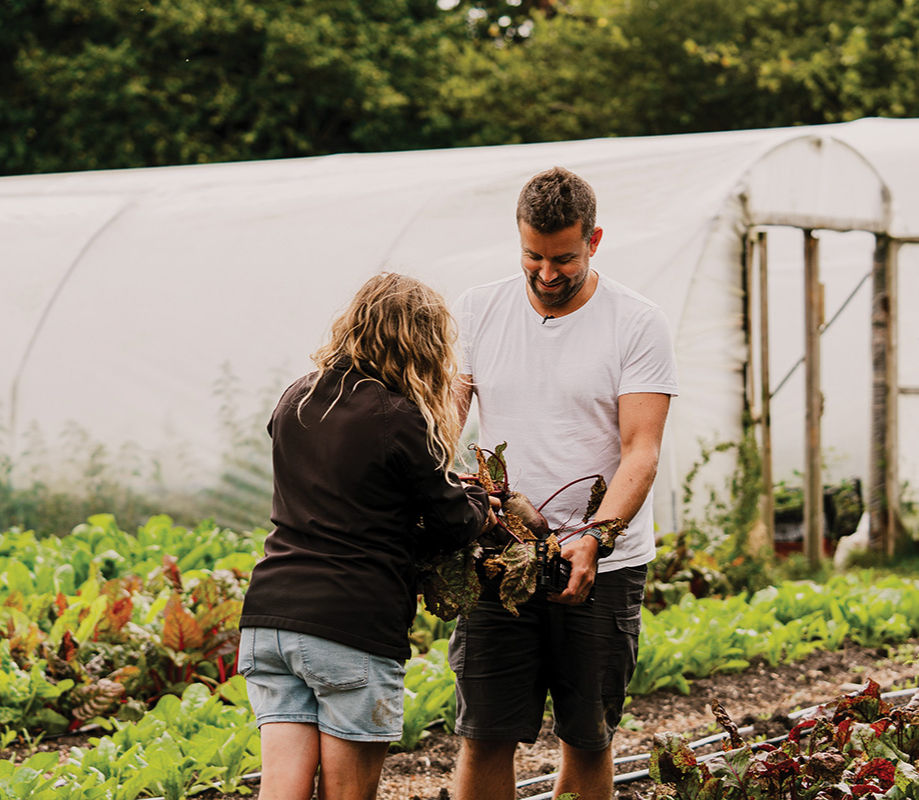
I would say our supplier relationships are more like friendships as we know exactly what’s going on in everyone’s lives. In the four years we’ve been open, we’ve seen everything from engagements, marriages, births and everything in between. It really is like having a whole extra family and we visit the farms and growers as much as we can throughout the year. Even our plates, were all made less than a stone’s throw from the restaurant by Sam Marks Ceramics.
And so, to dessert…?
My wife Petronella makes all of our desserts. Tonight, we’re serving the last of the Cornish lemons from Simon at Curgurrell Farm near Caerhays. And then tomorrow, she’ll be making her version of a tiramisu, but using locally roasted coffee from Rich at Forty Five who’s just around the corner from us and chocolate from Mike and his team at Chocolarder. I went to collect a big bag of chocolate last week after picking up my daughter from school. Everything really is so close.
Above: For chefs Hylton and Petronella, visiting suppliers is hugely important
And finally, why Culture?
We wanted a name that allowed us to be flexible in our style and so it represents not only the culture of our travels, our music, our religion, our love of wine, but also the culture of where we live, who we are and actually, the very culture of dining itself.
In recognition of their efforts, Culture was awarded Falmouth’s first MICHELIN Green Star in 2023.