The Enduring Call
Words by Jamie Crocker
An island hotel that encourages a feeling of being a world away.

Twenty-eight miles beyond mainland Cornwall, the Isles of Scilly form an outpost that feels sagaciously removed from the daily rush of the United Kingdom. The archipelago, unwilling to advertise its presence too much, lies low in the Atlantic, a scatter of islands and rocky outcrops surrounded by water that often carries a colour more usually associated with warmer latitudes. Boats crisscross the sound between islands bouyed up by the lilt of the waves, while seabirds wheel overhead, and the Gulf Stream moderates the climate so effectively that subtropical plants grow in the shelter of old stone walls. It is a landscape that draws the curious, where visitors quickly discover something familiar and yet peculiarly unfamiliar, a foreign land inhabited by friends.
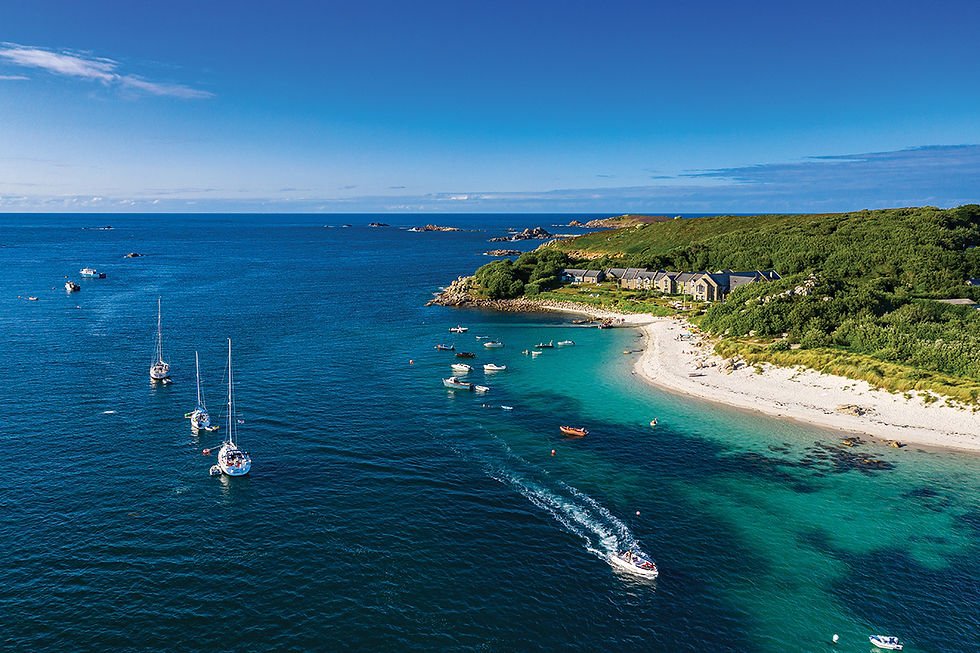
Among the inhabited islands, St Martin’s maintains a unique character. It lies towards the eastern edge of the group, long and narrow, its spine rising to low heathland and its shoreline folding into beaches of pale sand. Life here adopts a pace determined largely by the tide and the weather. There are farms and a handful of small businesses maintained by a real community. For visitors, the appeal is simple: space to walk, clear water for swimming in under skies that remain primordially dark once the sun drops below the horizon.
Set above the shore on the island’s western side stands Karma St Martin’s, the island’s only hotel, an establishment that has developed into one of the Isles of Scilly’s most comfortable places to stay. The property occupies a slope above Tean Sound, facing the neighbouring island of Tean and the wider Atlantic beyond. A group of granite buildings arranged along terraces form the heart of the hotel, their lines softened by gardens and salt-tolerant planting. From the outside, it has the appearance of a traditional island property that has grown organically over time rather than being parachuted in overnight.
Thirty guest rooms are spread throughout the buildings, each arranged to make the most of the view. Windows open towards the sea and most rooms include terraces or balconies that allow guests to sit outside when the weather allows, which it frequently does thanks to the warming influence of the Gulf Stream. The interiors draw lightly on the colours of the surrounding landscape: pale woods and simple fabrics which don't distract the eye, allowing the view to take centre stage. Nothing about the design is demanding beyond its requirements.
Guests can arrive at Karma St Martin’s in several ways. Many travel by fixed-wing aircraft or helicopter from the mainland, landing on nearby St Mary’s before continuing by boat. Others choose the slower but more romantic crossing aboard the passenger ferry from Penzance. However the journey is made, the final stage often involves a small inter-island boat ride, luggage stacked neatly beside the skipper while passengers watch the water shift between shades of turquoise and green. By the time the boat pulls into Higher Town quay on St Martin’s, most travellers have already begun to settle into island pace.
The hotel’s position makes it easy to reach the island’s network of paths. These tracks follow old field boundaries and low ridges, connecting beaches, farms and small outposts of human settlement. Walkers can circle the island in a few hours, though many choose to stretch the journey across a day, stopping to watch seals resting on offshore rocks or to study the view across the archipelago. On clear days the neighbouring islands appear as layered silhouettes, each separated by channels where boats chug between communities.
Lowertown Beach, only a short walk from the hotel, offers one of the island’s most striking stretches of sand. At low tide the water retreats to reveal long shallows and rippled sandbars, creating a wide expanse ideal for swimming or simply wandering. Families often spend entire afternoons here, while others carry picnics prepared by the hotel kitchen and settle among the dunes. The sea is clear enough to invite snorkelling and kayaking, both of which the hotel can arrange for guests interested in exploring the surrounding coves.
Island life has always been shaped by the sea, and that influence extends naturally to the hotel’s dining room. The Sir Cloudesley Shovell restaurant has held two AA Rosettes since 2018, a recognition that reflects the kitchen’s commitment to seasonal ingredients and fine dining. Fishing boats working around the islands land crab, lobster and scallops throughout the year, and much of this catch appears on the menu within hours of arriving ashore. The cooking style pays homage to the ingredients, allowing the freshness of the produce to dictate the way.
A typical evening might begin with hand-picked crab paired with garden herbs, followed by grilled lobster or locally caught fish served alongside island-grown vegetables. The kitchen also sources produce from mainland Cornwall and St Martin’s growers, whose small fields yield herbs, salads and occasional fruit. Desserts often take advantage of hedgerow berries in late summer and autumn, while the wine list ranges from familiar European regions to bottles chosen to complement seafood.
Lunch is relaxed. Guests might return from a morning swim to find the terrace tables set for light meals and fresh bread, or collect hampers prepared for a day spent exploring the island’s more distant beaches. Afternoon tea remains a popular ritual, particularly when the sun drops behind the terrace and the view across Tean Sound takes on a softer light.
Karma St Martin’s has also built a reputation as a welcoming place for travellers accompanied by dogs. The Isles of Scilly are well suited to animals as the paths are plentiful and beaches are rarely crowded. The hotel accommodates pets in designated rooms and public areas, allowing owners to explore the island without the complication of leaving their companions behind.
While many guests are content to remain on St Martin’s, the wider archipelago encourages exploration. Regular boats connect the inhabited islands, making it possible to spend a day visiting Tresco, Bryher or St Agnes before returning in time for dinner. Tresco is known for its Abbey Garden, where plants from across the world thrive in the mild climate. Bryher presents a contrast, its western side facing the full force of Atlantic weather while the eastern shore remains sheltered. Each island offers a slightly different character, yet all share the same sense of distance from mainland pressures.
Seasonality shapes life here. Spring arrives early, coaxed by the mild climate, and fields of narcissi begin to flower while much of Britain still waits for the first signs of growth. Coastal habitats fill with seabirds returning to breeding sites, and the water begins to warm enough for the first determined swimmers. Walk Scilly, an annual festival held across the islands, brings visitors eager to learn about local wildlife and geology from experienced guides.
Summer delivers longer days and the warmest sea temperatures of the year. Boats become busier as visitors move between islands, and the beaches take on the bright clarity often associated with mediterranean waters. Even then, the Isles of Scilly rarely feel crowded. The limited number of accommodation beds across the archipelago naturally controls the pace of tourism, ensuring that wide stretches of coast remain unoccupied for much of the day.
Autumn offers a mellow mood as the heather darkens across the hinterland and migratory birds arrive in large numbers, attracting enthusiasts from across Europe. The water retains warmth long after the mainland has cooled, encouraging late-season swims. The annual Taste of Scilly festival highlights local produce and brings chefs, growers and fishermen together in a series of events that celebrate the islands’ food culture.

Early October introduces another dimension to the calendar. Karma St Martin’s hosts a jazz gathering centred on performances by pianist Ben Waters and visiting musicians. Evenings in the hotel’s dining room or adjacent spaces fill with energetic boogie-woogie and blues, drawing audiences from afar. Around the same time, the archipelago participates in Dark Skies Week, when astronomers and enthusiasts gather for observations and talks organised through the COSMOS Community Observatory on St Martin’s. With minimal light pollution, the night sky here offers a rare opportunity to see the Milky Way clearly arching overhead.
Such events bring an element of vitality and exuberance to the closing months of the year, yet the hotel retains its essential character. Staffing often includes people who have spent many seasons on the islands, and their familiarity with local life gives the service a sense of embedded confidence. Visitors are quickly acquainted with where to watch the sunset, which path leads to a hidden cove, or how the tides affect the day’s swimming.
What draws people back to Karma St Martin’s repeatedly is a sense of residing abroad for a while, but without the hassle of having to pass through airports and customs checks. Days tend to organise themselves around simple activities: a walk along the coast, lunch outdoors, a boat trip to a neighbouring island, then dinner as the sky darkens over Tean Sound.
As dusk descends, the hotel’s lights flicker into life, mirrored in the sea that still holds the sunset’s last glow. Boats ease back to their moorings, and the island grows quiet, save for the gentle pull of the tide. Guests, returning from a day of exploration, linger on the terrace, sharing a final drink as the first stars appear. In that suspended moment, the distance from the mainland feels more than physical as Karma St Martin’s transforms into a place that exists beyond time and context, rare and unbound.